
🎯 Key Takeaways
- 15+ exam types available: MCQ, descriptive, case studies, AI interviews, coding tests, personality assessments, and more
- AI-powered assessments now evaluate communication skills, analytical ability, and domain knowledge through adaptive questioning
- Choose exam type based on learning objectives: knowledge recall (MCQ), critical thinking (case studies) or practical skills (coding/simulations)
- Modern platforms support multimedia questions, adaptive testing and real-time analytics for enhanced assessment quality
- Hybrid approaches combining multiple exam types provide the most comprehensive evaluation of candidate abilities
Understanding Online Exam Types
Online exams have evolved far beyond simple multiple-choice quizzes. Educational institutions and organizations have access to 15+ distinct assessment formats, each designed to evaluate different skills, knowledge levels and competencies.
The right exam type depends on your specific goals:
Knowledge recall? Use MCQs or true/false questions
Critical thinking? Deploy case studies and scenario-based assessments
Communication skills? Implement AI interviews or descriptive tests
Technical abilities? Choose coding tests or simulations
Comprehensive evaluation? Combine multiple formats in hybrid assessments
Three Main Assessment Categories
All online exams fall into three broad categories based on their purpose and timing in the learning journey:
- Pre-course placement tests
- Skill gap analysis surveys
- Entrance examinations
- Readiness assessments
- Weekly quizzes
- In-class polls and activities
- Practice tests
- Homework assignments
- Interactive simulations
- Final exams
- Certification tests
- End-of-semester assessments
- Professional licensing exams
- Capstone projects
Objective Assessment Types
Objective assessments have predetermined correct answers, making them easy to score automatically. They’re ideal for measuring knowledge recall, comprehension, and basic application.
1. Multiple Choice Questions (MCQs)
Most popular format for large-scale testing
Description:
Questions with 3-5 answer options where candidates select the single best answer. Variations include multiple-response MCQs allowing selection of several correct answers.
MCQ Variations:
- Single Best Answer (SBA): Traditional format with one correct option
- Multiple Response: Select all correct answers from the list
- Extended Matching Questions (EMQ): Multiple questions linked to a shared scenario or case study
- Scenario-Based MCQ: Questions embedded in realistic situations requiring application
Eklavvya MCQ Assessment Features
Create unlimited MCQs with multimedia support (images, videos), randomization, negative marking, sectional time limits and instant results with detailed analytics.
Explore MCQ Solutions →2. True/False Questions
Simple binary choice format
Description:
Statements that candidates mark as either true or false. Simplest objective format but high guessing probability (50%).
Enhancement Tips:
- Use “True/False/Not Given” format to reduce guessing (33% chance)
- Require justification for the answer to assess reasoning
- Combine with negative marking to discourage random guessing
3. Matching Questions
Connect related items from two lists
Description:
Two columns where candidates match items from Column A with corresponding items in Column B (terms with definitions, dates with events, concepts with examples).
Best Practice:
Use unequal numbers of items in each column (e.g., 7 terms to match with 10 definitions) to prevent elimination-based guessing.
4. Fill-in-the-Blank Questions
Complete sentences with missing words
Description:
Sentences or paragraphs with blank spaces where candidates type or select the correct word/phrase. Can be open-ended (type answer) or dropdown (select from options).
Implementation Tip:
For automated grading, use dropdown/select format or define multiple acceptable answers (synonyms, abbreviations) in the answer key.

- How AI helps in bettering online exams.
- Variety of applications of AI in education.
- Personalized learning experiences for students.
Subjective Assessment Types
Subjective assessments require open-ended responses evaluated based on content quality, analysis depth, and critical thinking. They assess higher-order skills but require human or AI evaluation.
5. Descriptive/Essay Questions
Long-form written responses demonstrating deep understanding
Description:
Open-ended questions where candidates write detailed answers (100-1,000+ words) explaining concepts, analyzing situations, or arguing positions.
AI-Powered Evaluation Revolution:
Modern platforms use generative AI to evaluate descriptive answers by:
- Content Analysis: Comparing student responses with model answers using NLP
- Concept Mapping: Identifying key concepts and their relationships in the answer
- Rubric-Based Scoring: Automated grading based on predefined criteria (accuracy, depth, structure)
- Plagiarism Detection: Identifying copied content or AI-generated text
- Feedback Generation: Providing personalized improvement suggestions
🤖 Eklavvya AI Descriptive Assessment
Leverage generative AI to automatically evaluate essay answers with 90%+ accuracy compared to human graders. Get detailed feedback reports, plagiarism checks, and instant grading at scale.
Explore AI Descriptive Tests →6. Short Answer Questions
Brief written responses (1-3 sentences)
Description:
Questions requiring concise written answers (25-100 words). Balance between objective and subjective, testing both knowledge and articulation.
Grading Strategy:
Use keyword-based auto-grading for factual questions, human review for explanatory questions. AI can flag responses needing manual review based on confidence scores.
7. Case Study Assessments
Real-world scenario analysis with AI evaluation
Description:
Candidates analyze realistic business scenarios, healthcare cases, legal situations, or technical problems, then provide recommendations or solutions. Generative AI creates dynamic cases and evaluates responses.
How AI-Powered Case Studies Work:
- Dynamic Scenario Generation: AI creates unique case studies tailored to candidate level and domain
- Adaptive Questioning: Follow-up questions adjust based on candidate’s initial responses
- Multi-Criteria Evaluation: AI assesses problem identification, analysis depth, solution quality, communication clarity
- Comparative Benchmarking: Compares response against expert model answers and peer performance
- Detailed Feedback: Provides strengths, weaknesses, and specific improvement areas
Use Cases Across Industries:
- Business/MBA: Market analysis, strategy formulation, financial decisions
- Healthcare/Medical: Patient diagnosis, treatment planning, ethical dilemmas
- Legal/Law School: Case analysis, legal reasoning, regulatory interpretation
- Engineering: System design, failure analysis, optimization problems
- HR/Management: Conflict resolution, employee management, organizational challenges
🚀 Eklavvya AI Case Study Assessment
Create interactive, AI-powered case studies that adapt to candidate responses. Evaluate communication, analytical ability, domain knowledge, and problem-solving skills automatically. Used by leading business schools and corporate training programs.
Explore AI Case Study Tool →
- Quicker evaluation of descriptive answers.
- Achieve more than 90% accuracy.
- Eliminate bias during evaluation.
8. AI-Powered Interviews
Intelligent adaptive interviews that scale to thousands
Description:
Generative AI conducts text or video-based interviews, asking follow-up questions based on candidate responses. Evaluates communication skills, motivation, analytical thinking, and domain knowledge at scale.
Key Features of AI Interviews:
- Adaptive Questioning: AI asks follow-up questions based on previous answers, just like human interviewers
- Multi-Format Support: Text-based, voice, or video responses depending on assessment goals
- Natural Language Understanding: Comprehends nuanced answers, not just keyword matching
- Sentiment Analysis: Evaluates confidence, enthusiasm, and communication tone
- Bias Elimination: Consistent criteria for all candidates regardless of demographics
- Instant Scoring: Real-time evaluation with detailed reports for reviewers
Real-World Impact:
A leading university used Eklavvya’s AI Interview to assess 13,000+ admission applicants. Results: 70% time savings, 60% cost reduction, improved fairness and personalization, faster decision-making. Read full case study →
Question Types in AI Interviews:
- Motivational: “Why do you want to join this program?”
- Situational: “How would you handle X situation?”
- Behavioral: “Tell me about a time when…”
- Technical: “Explain how X technology works”
- Problem-Solving: “How would you approach this challenge?”
🎯 Eklavvya AI Interview Solution
Conduct intelligent, adaptive interviews at scale. Perfect for university admissions, corporate hiring, and scholarship selection. AI evaluates communication skills, analytical ability, motivation, and program fit. Reduce interview time by 70% while improving quality.
Explore AI Interview Platform →
- Conduct interviews virtually at your convenience.
- Assess multiple skills with detailed feedback.
- Eliminate bias and errors in assessing candidates.
- Record responses and evaluate them later.
9. Coding & Programming Tests
Hands-on technical skill assessment with auto-evaluation
Description:
Candidates write actual code to solve problems. Platform compiles/runs code, checks output against test cases, and grades automatically. Supports 20+ programming languages.
Assessment Components:
- Algorithm Challenges: Data structures, sorting, searching, dynamic programming
- Debugging Tasks: Find and fix errors in provided code
- Code Completion: Fill in missing functions or logic
- System Design: Architecture planning for complex systems (for senior roles)
- SQL Queries: Database operations and optimization
- Frontend/Backend: HTML/CSS/JS or API development tasks
Automated Evaluation Criteria:
- Correctness: Does code pass all test cases? (visible + hidden)
- Efficiency: Time and space complexity analysis
- Code Quality: Readability, structure, best practices
- Edge Cases: Handling of boundary conditions and errors
- Optimization: Performance under large input sizes
💻 Eklavvya Coding Assessment Platform
Conduct high-stakes programming exams with secure browser lockdown, real-time code compilation, plagiarism detection, and automated grading. Perfect for technical hiring and computer science education.
Explore Coding Tests →
- Reduce hiring time of programmers by at least 50%.
- Evaluate more applications for Software Development.
- Bias-free competency-based coding skill tests.
- Assess languages like C, C++, Java, PHP, Python, etc.
Aptitude & Psychometric Tests
10. Aptitude Tests
Assess cognitive abilities and problem-solving skills
Description:
Measure analytical reasoning, numerical ability, verbal reasoning, logical thinking, and spatial awareness. Used for job screening, university admissions, and talent assessment.
Common Aptitude Test Types:
- Numerical Reasoning: Math problems, data interpretation, percentages, ratios
- Verbal Reasoning: Reading comprehension, grammar, vocabulary, critical reasoning
- Logical Reasoning: Patterns, sequences, syllogisms, puzzles
- Abstract Reasoning: Shape patterns, non-verbal logic
- Spatial Reasoning: 3D visualization, mental rotation tasks
11. Personality & Psychometric Tests
Understand behavioral traits and cultural fit
Description:
Assess personality traits, work style preferences, behavioral tendencies, and cultural alignment. No right/wrong answers—measures characteristics, not knowledge. Try a 20-question free psychometric test to see a sample Big Five profile.
What Psychometric Tests Measure:
- Openness: Creativity, curiosity, willingness to try new things
- Conscientiousness: Organization, reliability, goal-orientation
- Extraversion: Sociability, assertiveness, energy in social settings
- Agreeableness: Cooperation, empathy, teamwork orientation
- Neuroticism: Emotional stability, stress resilience
Use Case:
Organizations use personality tests to predict job performance, team compatibility, and leadership potential. Results guide hiring decisions, team composition, and professional development plans.
12. Communication Assessments
Evaluate written and verbal communication abilities
Description:
AI-powered assessments evaluate email writing, report drafting, presentation skills, customer communication, and professional correspondence. Critical for business roles.
Communication Assessment Scenarios:
- Email Etiquette: Draft professional emails to clients, colleagues, or vendors
- Business Reports: Create executive summaries, project reports, or analytical documents
- Customer Interactions: Respond to complaints, inquiries, or support requests
- Presentation Skills: Create and deliver compelling presentations (video/slides)
- Meeting Facilitation: Lead virtual meetings effectively
- Negotiation Simulations: Handle conflict resolution or vendor negotiations
AI Evaluation Criteria:
- Clarity: Is the message easy to understand?
- Professionalism: Appropriate tone for business context?
- Grammar & Structure: Correct language usage, logical flow
- Persuasiveness: Effective argumentation and influence
- Audience Awareness: Tailored to recipient’s needs and level
- Action Orientation: Clear next steps and calls-to-action
📧 Eklavvya Communication Assessment
AI-powered evaluation of written and verbal communication skills. Create realistic scenarios (emails, reports, presentations) and get instant feedback on clarity, professionalism, and effectiveness. Perfect for business hiring and soft skills training.
Explore Communication Tests →
- Conduct Assessments at your Time and Comfort.
- Comprehensive Language Proficiency Evaluation
- Conduct Hundreds of Concurrent Assessments.
- Eliminate the Need for Conducting Assessments In-Person
13. Oral/Viva Assessments
Oral examinations conducted online
Description:
Voice-based assessments where candidates answer questions verbally. Can be synchronous (live with examiner) or asynchronous (pre-recorded questions, recorded responses). Used for language tests, oral exams and viva.
Common Use Cases:
- Language Tests: English speaking assessment (TOEFL, IELTS style)
- Thesis/Dissertation Viva: Oral defense of research work
- Medical/Clinical Vivas: Patient case discussions, diagnosis explanation
- Pronunciation Tests: Phonetic accuracy for language learners
- Customer Service Training: Handling customer calls effectively
AI-Powered Voice Evaluation:
- Speech-to-Text: Automatic transcription of responses
- Fluency Analysis: Pace, pauses, filler words, clarity
- Pronunciation Scoring: Phonetic accuracy compared to native speakers
- Content Analysis: Relevance and accuracy of verbal answers
- Emotion Detection: Confidence, nervousness, engagement levels
🎙️ Eklavvya Audio Assessment
Conduct online viva voce exams with video recording, real-time evaluation, and AI-powered speech analysis. Perfect for language tests, oral examinations, and thesis defense. Supports both live and asynchronous formats.
Explore Audio Exams →14. Simulation-Based Assessments
Interactive hands-on skill evaluation
Description:
Interactive simulations where candidates perform tasks in realistic virtual environments. Used for technical skills, medical procedures, business decision-making, and safety training.
Simulation Types:
- Medical Simulations: Virtual patient diagnosis, surgical procedures, emergency response
- Engineering Labs: Circuit design, CAD modeling, system troubleshooting
- Business Simulations: Market strategy, resource allocation, crisis management
- Cybersecurity: Penetration testing, threat response, network defense
- Aviation/Driving: Flight simulators, driving tests, safety scenarios
- Software Training: Excel tasks, CRM usage, data analysis challenges
Advantage:
Simulations provide authentic assessment without real-world risks. Candidates demonstrate actual job performance, not just theoretical knowledge.
15. Generative AI Adaptive Assessments
Dynamic tests that adjust to candidate skill level
Description:
AI-powered assessments that dynamically adjust question difficulty based on candidate performance. Each test is personalized, providing more accurate skill measurement and better candidate experience.
How Adaptive Testing Works:
- Baseline Question: Test starts with medium-difficulty question
- Performance Analysis: AI evaluates answer correctness and response time
- Difficulty Adjustment:
- Correct answer → Next question is harder
- Incorrect answer → Next question is easier
- Continuous Refinement: Process repeats, honing in on candidate’s true ability level
- Precise Scoring: Final score reflects actual competency, not just number of correct answers
Advantages Over Traditional Testing:
- More Accurate: 30-50% fewer questions needed for same precision
- Time Efficient: Tests complete faster while maintaining accuracy
- Reduced Anxiety: Questions match skill level, preventing frustration
- Cheating Prevention: Every test is unique, making answer sharing impossible
- Immediate Insights: Real-time understanding of candidate strengths/weaknesses
🚀 Eklavvya Generative AI Assessments
Create adaptive tests that personalize to each candidate’s ability level. AI generates unique questions, evaluates responses intelligently, and provides detailed competency reports. Perfect for placement tests, skill assessments, and personalized learning paths.
Explore Generative AI Platform →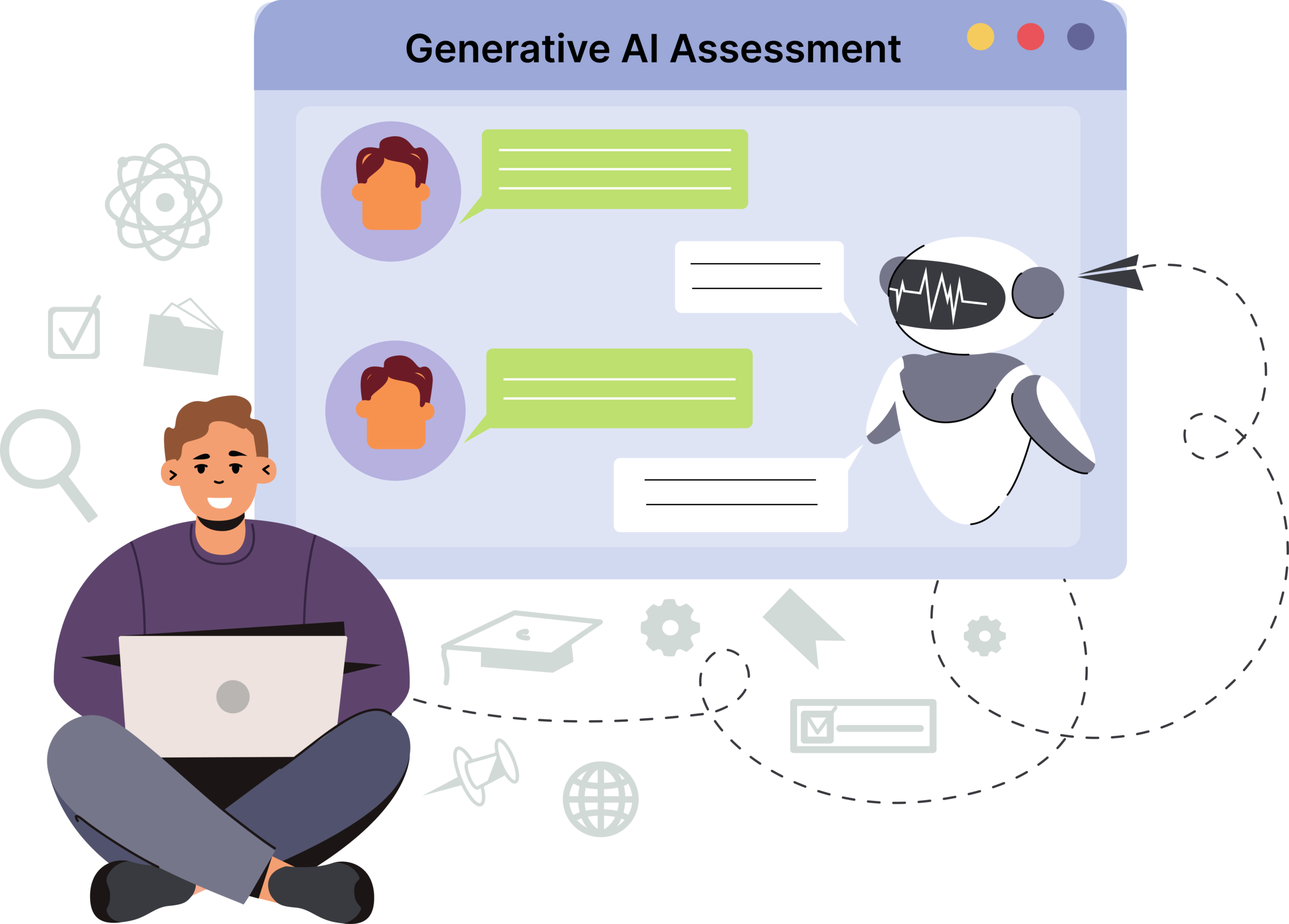
- Evaluate skills with real-world case studies.
- Instant feedback with skill ratings and areas of improvement.
- Dynamic assessment questions based on candidate responses.
Comparison Guide: Which Exam Type to Use?
Choosing the right assessment format depends on your learning objectives, time constraints, grading resources, and desired skill evaluation.
Here’s a comprehensive decision matrix:
| Exam Type | Best For Assessing | Grading Speed | Scalability | Depth of Evaluation |
|---|---|---|---|---|
| MCQ | Knowledge recall, comprehension | ✔ Instant | ✔ Unlimited | Low-Medium |
| True/False | Basic facts, misconceptions | ✔ Instant | ✔ Unlimited | Low |
| Descriptive | Critical thinking, analysis, writing | Slow (or AI-fast) | Medium (AI enables scale) | ✔ Very High |
| Case Studies | Problem-solving, real-world application | Medium (with AI) | ✔ High (AI-powered) | ✔ Very High |
| AI Interviews | Communication, motivation, soft skills | ✔ Instant | ✔ Unlimited | ✔ High |
| Coding Tests | Programming skills, logic | ✔ Instant | ✔ High | ✔ High |
| Aptitude Tests | Cognitive ability, reasoning | ✔ Instant | ✔ Unlimited | Medium |
| Communication Tests | Writing, presentation, persuasion | Medium (with AI) | ✔ High (AI-powered) | ✔ High |
| Audio/Viva | Verbal skills, spontaneity, language | Slow (or AI-fast) | Medium (AI helps scale) | ✔ High |
| Simulations | Practical skills, hands-on ability | ✔ Instant | Medium-High | ✔ Very High |
| Adaptive Tests | Precise skill level, competency | ✔ Instant | ✔ Unlimited | ✔ Very High |
Decision Framework: Choose Based on Goals
- Primary: MCQ, True/False
- Secondary: Fill-in-blanks, Short answer
- Why: Fast, objective, scalable
- Primary: Case studies, Essay questions
- Secondary: Simulations, Adaptive tests
- Why: Depth, real-world application
- Primary: Coding tests, Simulations
- Secondary: Practical assignments
- Why: Authentic performance measurement
- Primary: AI interviews, Communication tests
- Secondary: Audio/Viva, Personality tests
- Why: Behavioral insights, real interaction
- Approach: Hybrid exams
- Combine: MCQ + Case study + Interview
- Why: Complete candidate profile
- Primary: MCQ, Adaptive tests, AI interviews
- Enable with: Auto-grading, AI evaluation
- Why: Zero manual grading needed
Implementation Best Practices
General Guidelines Across All Exam Types
Align with Learning Objectives:
Choose exam types that match what you actually taught and want to measure
Use Bloom’s Taxonomy:
Knowledge/Comprehension → MCQ, True/False
Application/Analysis → Case studies, Short answer
Synthesis/Evaluation → Essays, Projects, Simulations
Mix Exam Types:
Hybrid approaches provide comprehensive assessment (e.g., 60% MCQ + 40% descriptive)
Provide Clear Instructions:
Explain format, time limits, grading criteria and expectations before the exam
Test Your Test:
Pilot with small group, identify confusing questions, adjust difficulty
Enable Accessibility:
Offer extended time, screen readers, alternative formats for students with disabilities
Use Rubrics:
For subjective questions, create detailed grading rubrics for consistency
Leverage AI Wisely:
Use AI for grading assistance, but keep human oversight for high-stakes decisions
Technical Implementation Tips
Randomization:
Shuffle question order and answer options to prevent cheating
Question Banks:
Create large pools so each student gets different questions
Time Limits:
Set appropriate per-question or per-section time limits
Proctoring:
Combine with AI proctoring for high-stakes exams
- Let AI monitor video, audio & screen activity.
- Scale without extra human invigilators.
- Secure candidate identity verification.
- Get complete audit trails & analytics.
Practice Tests:
Offer mock exams so students familiarize with format
Analytics:
Review question performance (too easy/hard) and refine over time
Backup Plans:
Have offline alternatives for technical failures
Choosing the Right Platform
Your online exam platform should support:
Multiple Question Types:
At least 15+ formats including AI-powered options
AI Evaluation:
Automated grading for essays, case studies, and coding
Proctoring Integration:
Built-in or compatible with AI/human proctoring
Scalability:
Handle 1,000+ simultaneous test-takers without lag
Analytics Dashboard:
Real-time insights into candidate performance
Accessibility:
WCAG 2.1 compliant for students with disabilities
Security:
Browser lockdown, anti-cheating measures, data encryption
Customization:
Branding, flexible grading, custom workflows
Frequently Asked Questions
Conclusion: Choosing the Right Assessment Mix
The landscape of online assessments has evolved dramatically. From traditional MCQs to AI-powered adaptive interviews, educators and organizations now have 15+ distinct exam types at their disposal, each serving unique evaluation needs.
Key Principles for Effective Assessment
Match Format to Objective:
Knowledge recall → MCQ; Critical thinking → Case studies; Practical skills → Simulations
Embrace Hybrid Approaches:
73% of institutions combine multiple formats for comprehensive evaluation
Leverage AI Intelligently:
Use generative AI for grading, adaptation and personalization but keep human oversight
Prioritize Authenticity:
Real-world scenarios, simulations, and practical tasks better predict actual performance than abstract questions
Scale Without Sacrificing Quality:
AI-powered evaluation enables depth assessment even for thousands of candidates
Related Guides
- How to Conduct Online Aptitude Tests: Complete Guide
- Psychometric Test for Hiring: Types & Examples
- Subjective & Descriptive Online Exams Guide
- How to Conduct Viva Online: Step-by-Step
- Remote Proctoring: Types & Best Practices
- 9 Innovative Assessment Methods Beyond Traditional Exams
- MCQ Online Test: Setup & Best Practices
- How to Prevent Question Paper Leaks
The Future of Online Assessments
The next generation of online exams will be characterized by:
Ubiquitous AI:
Every assessment type from MCQs to essays will have AI-assisted creation and grading
Hyper-Personalization:
Adaptive tests will customize not just difficulty but also question types, pacing, and feedback
Competency-Based:
Shift from time-based to mastery-based assessments measuring actual skill achievement
Multimodal Integration:
Combining text, voice, video, and interactive elements in single assessments
Continuous Assessment:
Moving from episodic exams to ongoing evaluation integrated into learning