Results day ends one queue and starts another. Within 15 days of results, students who doubt their marks must apply for a photocopy of the evaluated answer sheet and revaluation, and in most institutions that still means physical forms, counter payments and weeks of waiting.
The Supreme Court settled the right to see your own answer book back in 2011. The process for exercising that right is what remains broken.
This article looks at why the manual process frustrates students and exam cells alike, and how an online request portal turns it into a two-minute task.
Why this matters. In CBSE vs Aditya Bandopadhyay (2011), the Supreme Court held that evaluated answer books are “information” under the RTI Act and every examinee may inspect or obtain copies.
The stakes are real. Karnataka’s PU department told its legislature that 2,777 students were hit by wrong evaluation in three years, and one student’s score jumped from 40 to 99 after revaluation.
Meanwhile large universities routinely miss their own 45-day revaluation deadline, with waits stretching to two and a half months.
Every Controller of Examinations knows the season. Results go live, and the exam section drowns in photocopy forms, demand drafts and RTI applications.
Students see a black box. They paid a fee, and now they wait, with no way to check status except another trip to the counter.
The fix is not more counter staff. It is the same shift that transformed answer sheet checking itself: move the request, the payment and the delivery online.
📄 Why Students Ask for Photocopies and Revaluation
Students apply for a photocopy of the evaluated answer sheet when the declared marks do not match their expectation. The copy lets them verify three things: every answer was marked, totals were added correctly, and marking matched the scheme.
Revaluation is the next step. If the copy shows a genuine problem, the student pays for a fresh evaluation by a different examiner.
Universities use different names for the same requests: rechecking, retotaling, scrutiny of answer sheets, or a certified copy of the answer book. This guide uses the two most common terms, photocopy and revaluation.
The numbers say these requests are not paranoia.
For a university, each of those corrections is a student whose admission, placement or scholarship depended on a totalling slip.
Handled badly, the same requests become grievances, RTI appeals and court cases. Handled well, they become proof of transparency.
🎓 The Manual Process: What Students Actually Go Through
In most institutions the photocopy and revaluation process still looks like it did twenty years ago. The student travels to campus, sometimes across the state, for each step.
Every handoff adds errors. A wrong subject code on a handwritten form means a wrong photocopy three weeks later, past the revaluation deadline.
And the delays compound.
The photocopy takes weeks, but the revaluation window is 15 days from results. Students end up applying for revaluation blind, without ever seeing the marked answer book.
🏛️ What the Manual Process Costs the Examination Cell
The exam section pays for this process twice: once in staff hours, and again in disputes.
Each application means locating a physical answer book in a record room, photocopying it, masking examiner details, registering the fee and tracking the file. Multiply by thousands of applications in a two-week burst.
The hidden workload behind every photocopy season
- Physical retrieval of answer books from storage, one bundle at a time
- Manual masking of examiner names and signatures on every copy, as the RTI ruling requires
- Cash and demand draft reconciliation against handwritten registers
- No enforcement of limits, so ineligible or duplicate requests are caught late or never
- RTI applications and first appeals when responses cross the 30-day statutory clock
- Revaluation applications filed “just in case”, since students cannot see their copies in time
That last point deserves attention.
When students cannot inspect their answer sheet before the deadline, many pay for revaluation speculatively. Examiner time is then spent re-checking scripts that were fine, which slows down the genuine cases.
The result is the pattern every registrar recognises: revaluation results that miss their own 45-day rule by weeks, and a fresh cycle of complaints. Our guide to answer sheet evaluation challenges covers how the same bottlenecks affect first evaluation too.
💻 How an Online Photocopy and Revaluation Portal Works
An online photocopy and revaluation portal is a self-service window where students apply, pay and receive answer sheet copies without visiting campus. The institute defines the fees, subject limits and windows; the software enforces them.
Here is the flow, as it runs live today at Welingkar Institute of Management (WeSchool), Mumbai.
Notice what the student never does: copy a subject code by hand, stand in a payment queue, or wonder where the application is.
Notice what the exam cell never does: reconcile cash, validate eligibility manually, or explain status on the phone.
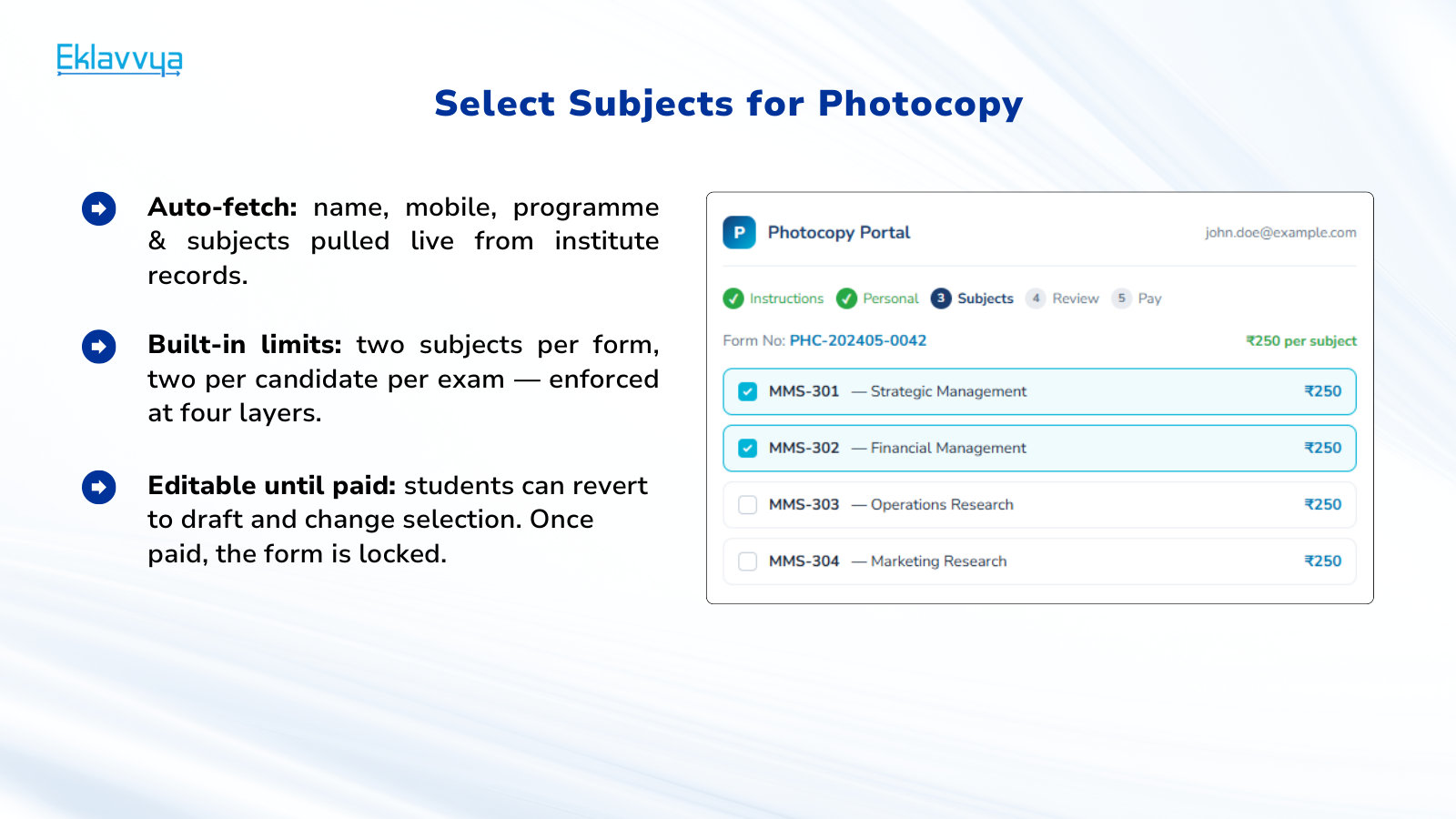
Subject selection on the portal: per-subject fees shown up front, limits enforced on screen, already-requested subjects greyed out.
The one rule that changes behaviour
The portal keeps the Apply for Revaluation button locked until the student has opened the photocopy of that subject.
This is deliberate design, not friction. Look at your answer sheet first, then decide whether a re-check is worth the fee.
Speculative applications drop, and the revaluation queue shrinks to cases where a student has seen something concrete to dispute.
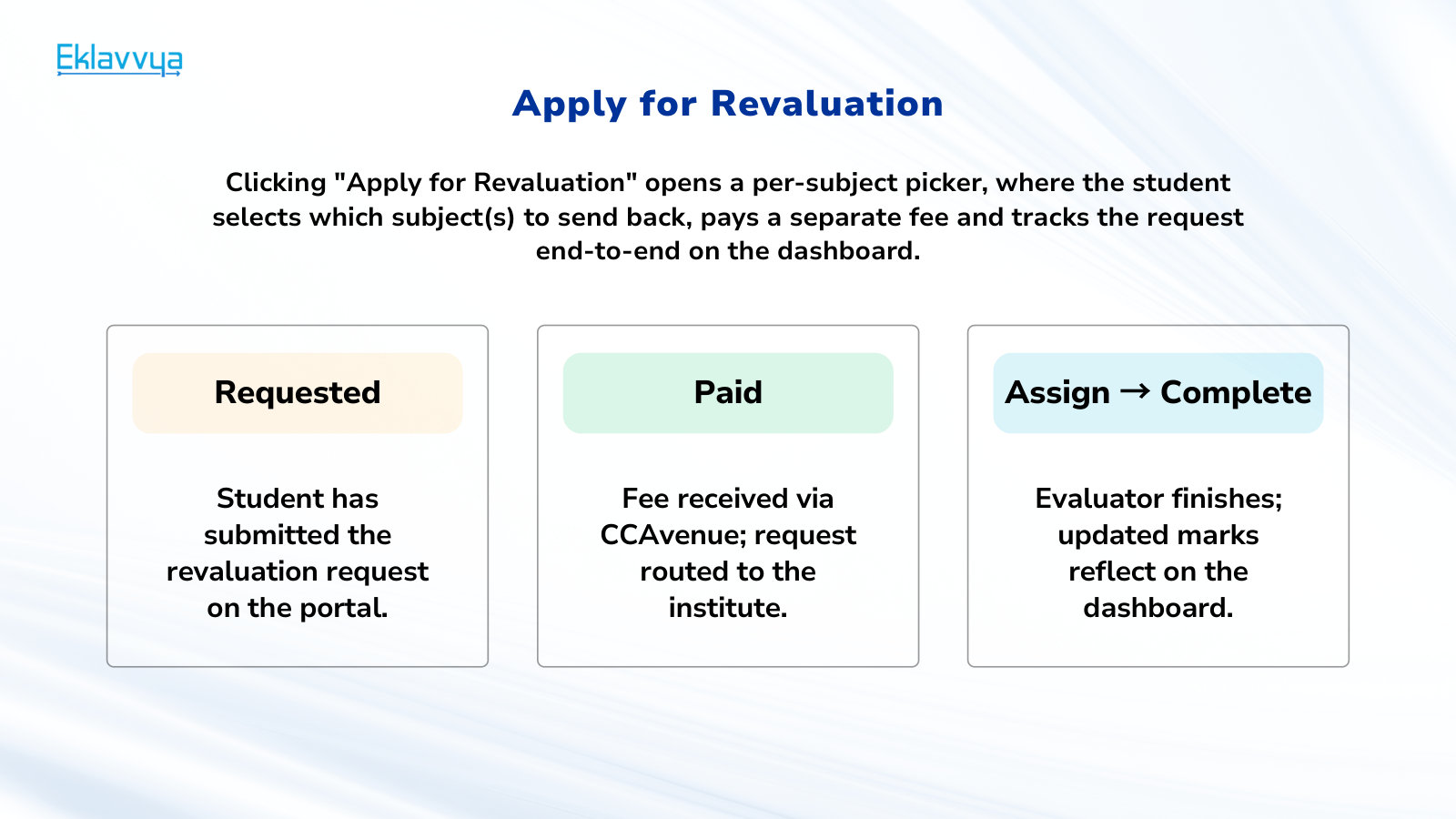
Every revaluation request moves through tracked states: requested, paid, assigned and completed, all visible to the student.
| Control | Manual process | Online portal |
|---|---|---|
| Application | ❌ Paper form at the counter, campus visit required | ✅ Self-service form, under 2 minutes from anywhere |
| Student data | ❌ Handwritten, error-prone subject codes | ✅ Auto-fetched from institute records via Seat No. and PRN |
| Fees | ❌ Cash or DD, manual reconciliation | ✅ Payment gateway with instant receipts per request |
| Eligibility limits | ❌ Checked by clerks after submission | ✅ Enforced on screen; ineligible subjects greyed out |
| Delivery | ❌ Physical collection after 2-4 weeks | ✅ PDF in the dashboard, typically within 2-3 hours |
| Revaluation gate | ❌ Applied blind before seeing the copy | ✅ Unlocks only after the photocopy is viewed |
| Audit trail | ❌ Registers and files, assembled on demand | ✅ Every request, payment and download time-stamped |

- Deliver answer sheet photocopies in hours, not weeks.
- Collect photocopy and revaluation fees online.
- Enforce subject limits and deadlines automatically.
- Keep a time-stamped audit trail of every request.
🖥️ Why Onscreen Marking Makes Photocopies Instant
A photocopy portal is only as fast as the answer sheet behind it. This is where onscreen marking changes the economics.
In an onscreen evaluation workflow, answer books are scanned once, student identities are masked with QR codes, and examiners mark on screen with every annotation and mark stored digitally.
When a photocopy request arrives, there is no record room to visit. The marked answer sheet already exists as a PDF, with examiner identity masking built in from the start.
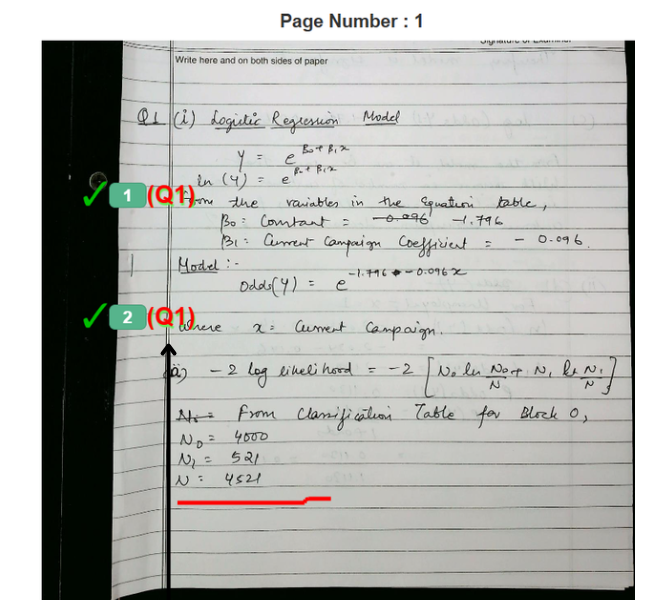
What the student downloads: the evaluated answer sheet with question-wise marks and examiner annotations from onscreen marking.
Revaluation benefits even more than the photocopy does.
The script goes to a different examiner digitally, the second evaluation is logged next to the first, and exam analytics can flag examiners whose marks shift consistently on re-checks.
Institutions running Eklavvya’s onscreen marking evaluate 100,000+ answer sheets per session this way. The digital evaluation guide explains the full workflow, and AI answer sheet checking shows where AI now assists the first evaluation itself.
🎓 Case Study: WeSchool’s Online Photocopy and Revaluation Portal
Welingkar Institute of Management Development and Research (WeSchool), Mumbai, moved its photocopy and revaluation requests to a dedicated online portal built on the ePravesh registration engine, part of the same product family as Eklavvya.
Students sign in with their official institute email, and the portal pulls their programme and subject list from institute records using just the Seat Number and PRN.
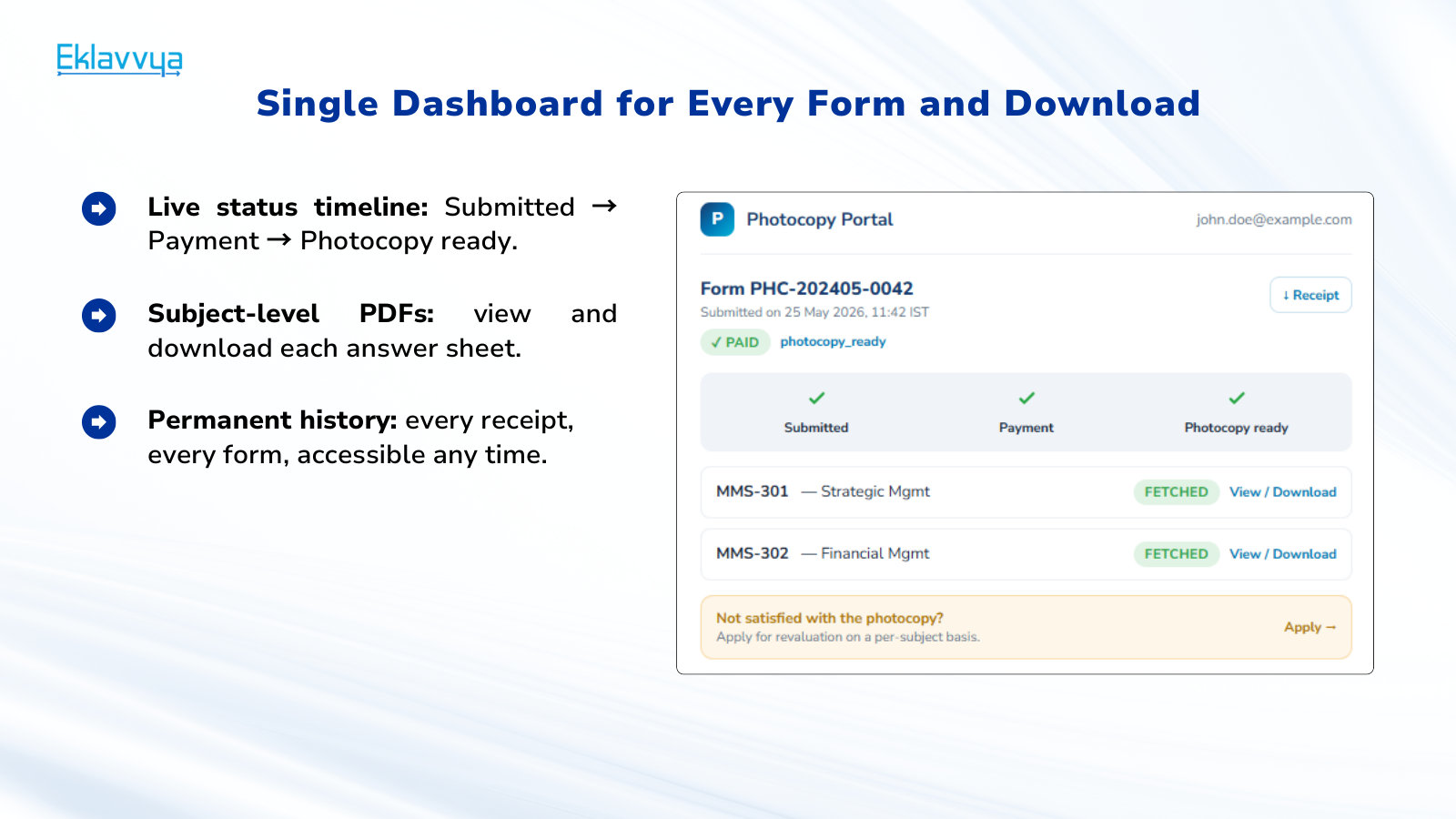
The student dashboard: live status timeline, per-subject answer sheet downloads, receipts and the revaluation entry point in one place.
The policy rules that used to live in clerks’ heads are now enforced by the system.
Forms lock after payment, so subjects cannot be swapped later. Already-requested subjects are greyed out. Revaluation stays locked until the photocopy has been opened, and a re-evaluated subject cannot be submitted twice.
Search across records means the exam office finds any request in seconds when a student calls, instead of pulling a file.
💡 Key Takeaways
- Students have had the legal right to copies of evaluated answer sheets since the Supreme Court’s 2011 CBSE vs Aditya Bandopadhyay ruling. The bottleneck is process, not policy.
- Evaluation errors are common enough to matter: 2,777 students in Karnataka PU alone were affected by wrong valuation in three years.
- Manual photocopy delivery takes 2-4 weeks, often longer than the 15-day revaluation window, forcing students to apply for revaluation blind.
- An online portal compresses application to under 2 minutes and delivery to 2-3 hours, with fees collected through a payment gateway.
- Gating revaluation behind viewing the photocopy cuts speculative applications and shrinks the re-check queue to genuine disputes.
- Onscreen marking makes the whole model instant, because every evaluated answer sheet already exists as a masked, audit-trailed PDF.
🗺️ A 4-Week Implementation Plan
Unlike a full examination platform migration, a photocopy and revaluation portal can go live between two result cycles.
Institutions on Eklavvya’s university examination management stack typically follow this sequence.
📋 Freeze the Rules and the Data
Decide fees per subject, the subject cap, the application window and the revaluation policy.
Load candidate records (Seat Number, PRN, programme, subject list) so the portal can auto-fetch details and validate eligibility.
💳 Configure the Portal and Payment Gateway
Brand the portal, connect the payment gateway, and map fee heads for photocopy and revaluation separately.
Set up the answer sheet source: the onscreen marking archive, or a scanning workflow for paper-evaluated scripts.
🧪 Pilot With One Programme
Run one programme’s supplementary cycle through the portal. Test the locked-form rule, the revaluation gate and receipt generation.
Verify the exam office can search and export every request.
🚀 Open to All Candidates
Publish the portal link with results. Retire the counter forms.
Track applications, payments and delivery times from the admin dashboard instead of registers.
The platform behind this serves 200+ universities and examination bodies including TISS, NMIMS and WeSchool, from online exams and AI-proctored assessments to government exams at 250+ locations.
“Eklavvya platform helped us conduct exams for over 10,00,000 students with accuracy and security.”
– Client testimonial, Eklavvya assessment for education institutes
🧭 The Way Forward: Transparency as a Service, Not a Concession
Photocopy and revaluation requests are not going away. Court rulings, student awareness and competitive stakes all push the volume up each year.
Institutions can keep absorbing that volume with counters and registers, or they can treat answer sheet access as a digital service with the same standards as admissions and results.
The institutions that choose the second path get a quieter exam office, a shorter revaluation queue, and students who trust the marks because they can see them.
- Deliver answer sheet photocopies in hours, not weeks.
- Collect photocopy and revaluation fees online.
- Enforce subject limits and deadlines automatically.
- Keep a time-stamped audit trail of every request.
❓ Frequently Asked Questions
What is a photocopy of an evaluated answer sheet?
It is a copy of the student’s own answer book after evaluation, showing the marks awarded to each answer.
In CBSE vs Aditya Bandopadhyay (2011), the Supreme Court of India held that examinees have the right to inspect and obtain copies of their evaluated answer books. Most universities charge a per-subject fee for the copy.
How does an online photocopy and revaluation request portal work?
The student signs in with an institute email, enters the Seat Number and PRN, and the portal fetches name, programme and subject list from institute records automatically.
The student selects subjects, pays online through a payment gateway, and the photocopy PDF appears in the dashboard, typically within 2-3 hours.
Revaluation for a subject unlocks only after the student has opened its photocopy.
Why should students view the photocopy before applying for revaluation?
Viewing the marked answer sheet first lets the student check for totalling errors or unmarked answers before paying a revaluation fee.
This gate reduces speculative revaluation applications, so examiners re-check only cases where the student has seen a genuine reason to dispute the marks.
How fast can a photocopy be delivered through an online portal?
When answer sheets are already scanned or evaluated onscreen, the photocopy is a digital fetch rather than a physical retrieval.
Portals built on this model, such as the Welingkar Institute (WeSchool) deployment, deliver the answer sheet PDF to the student’s dashboard within 2-3 hours of payment.
Does an institute need onscreen marking to offer online photocopies?
Onscreen marking makes it easiest, because every evaluated answer sheet already exists as a marked digital file with an audit trail.
Institutes that still evaluate on paper can offer the same portal by scanning answer books after evaluation, though delivery then depends on scanning turnaround.