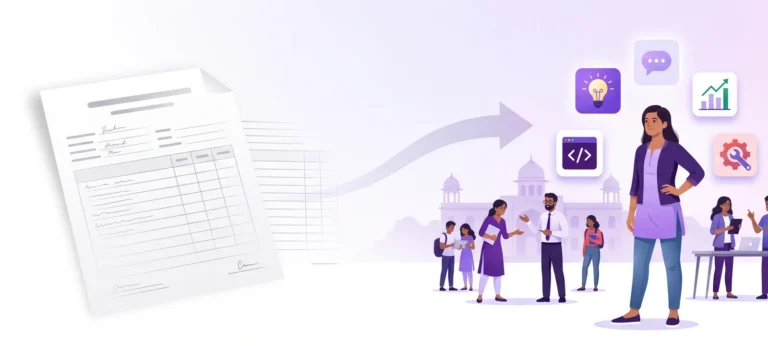
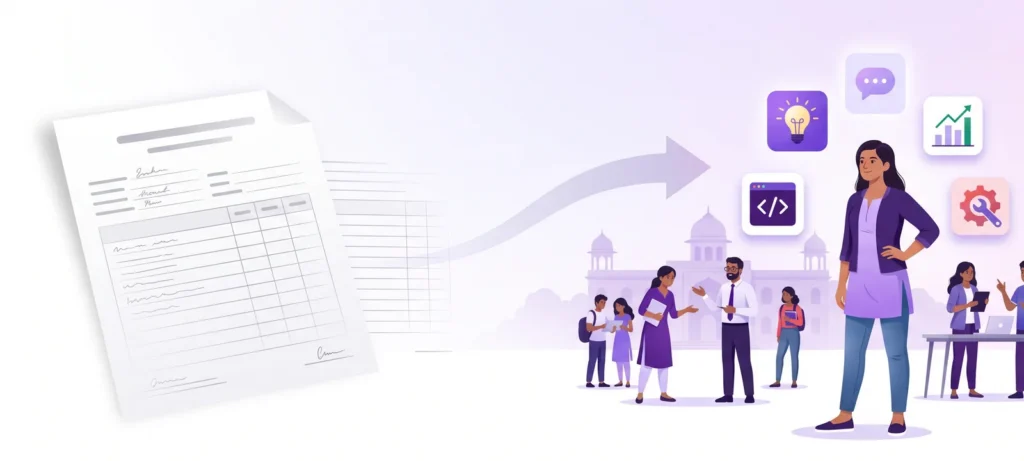
A B.Com graduate scores 72% in her final year. Her transcript looks the same as that of a classmate who wrote every assignment with an AI chatbot.
The recruiter across the table cannot tell them apart, and neither can the university that awarded both degrees.
That is the problem competency-based assessment in higher education is built to solve.
What changed in 2026. CBSE board papers now test application over memory, with case studies, data interpretation and real-world scenarios making up about half the paper. Five state boards have followed with competency question banks.
Employers moved too. In a September 2026 survey, employers said AI has made real skills harder to evaluate, and 42% plan to focus more on skills than degrees.
A 2026 paper in Science, drawing on 95,513 students at 20 research universities, concluded that GenAI use and misuse call for assessment reform.
Sources: Business Today, Careers360, WGU Workforce Decoded, Berkeley CSHE, India Skills Report 2026, Ministry of Education (NCrF).
Most registrars and deans we speak to already sense the shift.
The harder questions are practical.
What does “competency-based” mean for a semester exam with 4,000 candidates?
How do you show skills, not just marks, without doubling faculty workload?
And how does it fit with NEP, NCrF and accreditation, which are all asking for something similar?
This guide answers those in four parts.
🤖 Why a Marksheet No Longer Proves Skills in the AI Era

A marksheet reports how much of a syllabus a student reproduced under exam conditions. It was always a proxy for skill, and generative AI has made that proxy much weaker.
When a chatbot can draft an essay, a case analysis or a lab report in seconds, a good grade on take-home work proves very little.
Employers have noticed. The same WGU survey found that employers who struggle to evaluate skills are far more likely to have cut entry-level hiring: 54% of them, against 20% of other employers.
The employability gap is really a measurement gap
The India Skills Report 2026 rates 56.35% of Indian graduates as employable on a standardised test.
The spread across streams is wide, and every one of these students holds a degree.
A 62.81% employability rate in commerce means roughly one in three commerce graduates did not clear a skills test, despite passing every university exam.
The university exams did not measure the skills the test did. That is the gap competency-based assessment closes.
Redesigning assignments alone is not enough
Many universities have responded by moving away from take-home essays toward oral exams, presentations and practicals.
That helps, but a 2025 University of Greenwich study found that “authentic” assessment on its own does not protect academic integrity.
Two things still matter: what each question measures, and under what conditions it is answered. Our guide to assessment methods beyond traditional exams covers the formats; the rest of this article covers the measurement.
🏛️ Exam Reform Is Already Moving From Recall to Application

Indian exam reform has been heading toward competency-based assessment for several years. School boards moved first; higher education now has to catch up.
Students entering college from 2027 will have sat board papers where half the marks reward application.
A first-semester exam that asks them to reproduce definitions will feel like a step backwards.
| Reform | What it changes | What it asks of a university exam cell |
|---|---|---|
| 📜 NEP 2020 | Moves assessment from summative, rote-based exams to regular, formative, competency-based evaluation. | Assess skills continuously, not only at semester end, and report more than a subject total. |
| 📝 CBSE 2026 board pattern | About half the questions are competency-based: case studies, data interpretation, source-based and real-world problems. Class 10 gets two board exams a year. | Incoming students are trained on application items. College papers should continue that progression. |
| 🏫 State board question banks | Haryana, Chhattisgarh, Uttarakhand and others have built competency-tagged question banks for teachers. | Tagged question banks are becoming the norm. Untagged banks cannot produce skill evidence. |
| 🏦 NCrF, ABC and APAAR | One credit framework across school, higher and skill education. 1 credit = 30 notional hours, stored in the Academic Bank of Credits against a student’s APAAR ID. | A skill credit needs evidence that the skill was demonstrated. Assessment is that evidence. |
| 🎯 Outcome-based education (NAAC / NBA) | Accreditation already asks for course outcome and programme outcome (CO-PO) attainment. | Skill-wise scoring is the same idea applied per student, so it doubles as accreditation evidence. |
Notice the common thread. Every instrument asks for evidence of what a student can do, not a percentage of syllabus recalled.
Our NEP 2020 assessment guide covers the policy detail, and the CO-PO mapping guide covers the accreditation side.
Traditional semester exam vs competency-based assessment
| What you need | Traditional semester exam | Competency-based assessment |
|---|---|---|
| Result format | ❌ One total per subject | ✅ A score for every skill, plus the total |
| Question design | ❌ Mostly recall and reproduction | ✅ Each item tagged to skills and a Bloom’s level |
| AI resistance | ⚠️ Weak for take-home work | ✅ Supervised, application-based, proctored where needed |
| Feedback to students | ❌ “You scored 64%” | ✅ “Strong in analysis, developing in written communication” |
| Cohort insight | ❌ Pass rates and averages | ✅ Skill heat map showing where the whole batch is weak |
| Credits and accreditation | ❌ Evidence assembled by hand | ✅ Skill evidence produced by the exam itself |
| Employer value | ❌ Marksheet only | ✅ A skill profile recruiters can read |
🧩 How Competency-Based Assessment Analyses a Learner’s Skills
Competency-based assessment turns one test into many skill scores. It does this by deciding what each question measures before anyone answers it.
A competency is a skill a student can demonstrate under defined conditions. For example, “interprets a financial statement and identifies two risks” is a competency; “knows accounting” is not.
The six-step method
Step 1-2: Define skills, then tag every question
Start with a short skill list for the programme: analytical reasoning, domain application, written communication, digital and AI literacy, problem solving.
The skills can come from a standard framework such as NSQF, or from your own graduate attributes.
Then tag every question with the skills it tests and its Bloom’s level. One case-study question might count toward both analysis and written communication.
Our article on writing exam questions that truly assess skills and the Bloom’s taxonomy guide go deeper on item design.
Step 3-4: Use formats that show doing, not recall
Recall questions still have a place, but skills show up in applied formats.
Because AI can answer unsupervised work, the conditions matter as much as the format. High-value skill tests should run under AI proctoring or at a supervised centre. See the AI proctoring guide for when each fits.
Step 5: Report by skill, not just by total

This is where the method pays off. A student who scored 68% gets more than a number.
What a skill-wise report shows
- Marks by skill for each student, so “68%” becomes “strong in data interpretation, developing in written communication”
- Proficiency bands such as beginner, developing, competent, proficient and excellent, instead of raw percentages
- A question-by-skill heat map for the cohort, showing which skills an entire batch is missing
- Identified strengths and areas for improvement, with a question-by-question breakdown
- Bloom’s-level spread, so faculty can see whether a paper actually tested higher-order thinking
Platforms built for this, such as Eklavvya’s skill-based assessment module, produce these reports directly from the tagged questions. No one has to re-map marks to skills in a spreadsheet afterwards.
AI scores first, and doubtful answers route to faculty evaluators for review.
Step 6: Act on it, every term
A skill report is only useful if it changes something. The cohort heat map tells the department which skill to reteach.
The student report tells the placement cell who is ready for which role, and gives students a reason to care about feedback.
For the full mechanics of skill tagging and reporting, read skill-based assessment in education: measure skills, not just scores.

- Tag every question to skills and Bloom’s levels.
- Report marks by skill, not just one total.
- Spot cohort gaps with a skill heat map.
- Run it proctored, online or at centres.
🗺️ How Universities Can Adopt Competency-Based Assessment

You do not need to rebuild the exam system. The institutions that adopt this fastest start with one programme, re-tag exams they already run, and expand once faculty see the reports.
Pick programmes where placement pressure is highest, such as MBA, engineering or commerce. The skill reports earn faculty buy-in quickly there.
🧪 Pilot in One or Two Programmes
Define 5-8 skills with the programme faculty. Re-tag one existing internal exam in the question bank by skill and Bloom’s level.
📍 Run a Baseline Skill Test
Test incoming students at entry. Share skill reports with students and faculty, not just marks.
The baseline becomes the “before” for every later comparison.
🧱 Embed in Continuous Assessment
Convert internal assessments to skill-tagged items. Add one supervised practical, oral or case component per course to keep the measurement AI-resistant.
Use exam analytics to check that papers actually span higher Bloom’s levels.
🔗 Link Skills to Credits and Accreditation
Map assessed skills to NCrF credits and micro-credentials. Reuse the same skill data as CO-PO attainment evidence for NAAC and NBA.
Share cohort skill profiles with recruiters during placements.
Common objections, and what answers them
| Objection | What answers it |
|---|---|
| “Faculty do not have time to tag questions.” | Tag once, reuse every term. AI-assisted question creation can draft tagged items for faculty to accept or reject. |
| “Students will still use AI.” | Keep skill tests supervised: proctored online or at a centre, with application-style items that cannot be looked up. |
| “It breaks our semester structure.” | It sits inside the existing structure. Marks still roll up to the same totals; the skill view is added alongside. |
| “Our regulator has not mandated it.” | NEP, NCrF and accreditation already ask for competency evidence. Starting early means the data exists when it is asked for. |
Write an AI-use policy at the same time
UNESCO estimates that fewer than 10% of schools and universities have formal guidance on AI.
Publish a short, course-level policy that says when AI tools are allowed, as in project work, and when skills are tested without them, as in supervised skill assessments. Students accept supervised tests more readily when the rules are clear in advance.
Readiness checklist for the exam cell
- A skill list agreed for each pilot programme, mapped to graduate attributes or a standard framework
- Every question in the pilot bank tagged by skill, weightage and Bloom’s level
- At least one supervised or proctored skill test per course
- Skill-wise reports shared with students, not only stored by the department
- Cohort heat maps reviewed by faculty each term to plan reteaching
- Skill data mapped to credits and CO-PO attainment for accreditation files
- A published course-level policy on acceptable AI use
💡 Key Takeaways
- Generative AI has made take-home work and single subject totals weak proof of skill, and employers are moving to skills-first hiring.
- India Skills Report 2026 rates only 56.35% of graduates employable, a gap between what degrees certify and what employers test.
- CBSE 2026 papers carry about half competency-based questions. Students arriving in college will expect application-style assessment.
- NEP 2020, NCrF and NAAC/NBA outcome attainment all ask for evidence of skills, which only skill-tagged assessment produces at scale.
- Competency-based assessment tags every question to skills and a Bloom’s level, then reports marks by skill and a cohort heat map.
- Supervised conditions still matter: redesigned assignments alone do not protect integrity.
- Start with one programme, re-tag an existing exam, and expand over one to two years.
🏆 Assessment at Scale, Already Running
The infrastructure for supervised, skill-tagged assessment is not hypothetical. Universities and examination bodies across India already run it on Eklavvya.
See how these institutions run university examination management and assessment for education institutes on one system.
“Eklavvya platform helped us conduct exams for over 10,00,000 students with accuracy and security.”
– Client testimonial, Eklavvya assessment for education institutes
🧭 The Way Forward: Measure Skills Before You Are Asked To

AI will keep getting better at producing the outputs universities used to grade. The degree will only keep its value if it carries evidence of what the graduate can actually do.
School boards have already moved to competency-based papers. The credit framework is waiting for skill evidence, and employers are asking for it in every hiring cycle.
Universities that start measuring skills now will have that evidence ready, while those that wait will have to build it in a hurry once regulators or recruiters demand it.
- Tag every question to skills and Bloom’s levels.
- Report marks by skill, not just one total.
- Spot cohort gaps with a skill heat map.
- Run it proctored, online or at centres.
❓ Frequently Asked Questions
What is competency-based assessment in higher education?
Competency-based assessment measures what a student can do, skill by skill, instead of reporting one total mark per subject.
Every question is tagged to one or more skills and a Bloom’s level, so a single test produces a profile of strengths and gaps that faculty, students and employers can act on.
How has AI changed assessment in universities?
Generative AI can now produce essays, assignments and model answers in seconds, so take-home work no longer proves that a student holds the skill.
Universities are shifting to supervised, application-based and oral or practical assessment, and employers increasingly hire for demonstrated skills over degrees.
How is competency-based assessment linked to exam reforms in India?
NEP 2020 asks for regular, formative, competency-based evaluation instead of rote summative exams. CBSE’s 2026 board papers carry about half competency-based questions, and the National Credit Framework awards credits for skills.
Each of these needs assessment that records evidence of a skill, not just a subject total.
Does competency-based assessment replace semester exams?
No. Most universities keep their semester structure and re-tag existing internal assessments to skills.
Over one to two years they add application-style items, one supervised practical or oral component per course, and skill-wise reports alongside marks.
How long does it take a university to adopt skill-based assessment?
A pilot in one or two programmes fits inside a single term: define 5-8 skills, tag one internal exam and share skill reports.
Embedding it across a programme and linking skills to credits and accreditation evidence typically takes one to two academic years.