Only 12-13% of India’s 45,473 colleges hold NAAC accreditation. UGC now targets 90-95% coverage within five years. For the remaining 87% of institutions, the clock is ticking on NEP 2020 assessment compliance – and the cost of inaction is losing the power to award degrees.
NEP 2020 fundamentally rewrites how 1,168 universities and 45,473 colleges must assess 46.5 million students. Traditional annual examinations testing rote memorization are being replaced by continuous, competency-based assessment aligned to defined learning outcomes.
UGC’s 2025 regulations make Outcome-Based Education (OBE) mandatory for all UG and PG programs. Non-compliance risks restrictions on awarding degrees. NAAC’s new binary accreditation system uses AI-driven verification to validate whether your assessment practices match your claims. And the Viksit Bharat Shiksha Adhishthan Bill 2025 will replace UGC, AICTE, and NCTE with a single regulatory body – raising enforcement standards further.
Yet most institutions remain unprepared. Only 38% of teachers believe NEP aligns with local student needs. Faculty training infrastructure is thin. And the shift from “what to think” to “how to think” demands entirely new question paper design, evaluation methods, and assessment tracking systems.
This guide breaks down every assessment requirement NEP 2020 mandates for your university – from CO-PO mapping and Bloom’s taxonomy to digital evaluation infrastructure. You’ll get a practical implementation roadmap, not policy theory.
In This Article
ToggleNEP 2020 Assessment: The Numbers That Matter
1. Why NEP 2020 Changes Everything About University Assessment
For decades, Indian higher education assessment followed a predictable pattern: annual examinations, memory-based question papers, manual evaluation over 45 days, and a percentage score that told you almost nothing about what a student actually learned. NEP 2020 dismantles this entire model.
“The National Education Policy shifts focus from ‘what to think’ to ‘how to think’.”
– Prime Minister Narendra Modi
The policy mandates a shift from summative assessment that primarily tests rote memorization to one that is regular, formative, and competency-based – testing higher-order skills such as analysis, critical thinking, and conceptual clarity. Here’s what changes:
| Traditional System | NEP 2020 System |
|---|---|
| Annual high-stakes exams | Semester-based continuous assessment |
| Rote memorization focus | Higher-order thinking skills (HOTS) |
| Single mark/percentage | 360-degree multidimensional progress cards |
| Content coverage | Outcome-based learning with CO-PO mapping |
| One entry, one exit | Multiple entry/exit with ABC credits |
| Paper-based evaluation (45 days) | Digital AI-powered assessment (8 days) |
| Manual CO-PO tracking in Excel | Automated OBE analytics dashboards |
The Regulatory Pressure Is Real
This isn’t aspirational policy language. It’s backed by enforcement mechanisms:
- UGC’s 2025 regulations make OBE mandatory for all UG and PG programs – non-compliance risks restrictions on degree-awarding powers
- NAAC’s binary accreditation now uses AI-driven validation. No more CGPA grades – your institution is either Accredited or Not Accredited
- NAAC Chairman Prof. Sahasrabudhe targets 90-95% accreditation coverage within 5 years: “We believe in trust, but with verification”
- 67% of NEP 2020 has been implemented nationwide. The remaining 33% is primarily assessment and infrastructure reform – the hardest part
- The Viksit Bharat Shiksha Adhishthan Bill 2025 will replace UGC, AICTE, and NCTE with a single umbrella commission, raising enforcement standards further
Semester-based assessment already shows measurable results: a 43% reduction in student stress compared to annual exam systems, according to PIB data. The question for your institution isn’t whether to change. It’s how quickly you can implement the changes NEP demands.
2. Seven Assessment Changes Every University Must Implement Under NEP 2020
NEP 2020’s assessment mandates aren’t abstract principles. They are specific, verifiable requirements that NAAC and NBA auditors will check. Here are the seven changes your institution needs to implement.
1 Shift from Summative to Continuous Assessment
Replace the single end-of-term exam model with ongoing formative evaluation throughout the semester. Under UGC’s NEP-aligned framework, the standard weightage is:
- 60% End Semester Examination (ESE) – The traditional component, but now testing higher-order thinking
- 40% Continuous Internal Assessment (CIA) – Mid-terms, quizzes, assignments, seminars, lab work, presentations, and project evaluations
The impact is significant. A university that previously ran one evaluation cycle per year now runs 3-4 assessment cycles per semester. For an institution with 50,000 students, that’s 200,000+ evaluations per year instead of 50,000. Without digital evaluation tools, this volume is simply unmanageable.
2 Outcome-Based Education (OBE) Framework
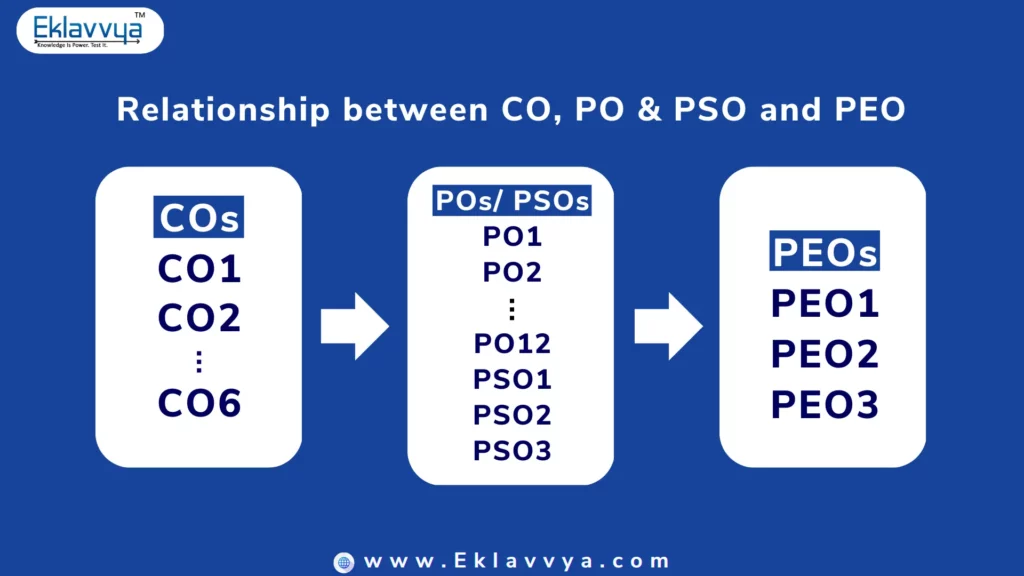
Every academic program must define measurable outcomes at four hierarchical levels (see our primer on outcome-based education):
- Program Educational Objectives (PEOs) – Career achievements expected 3-5 years after graduation
- Program Outcomes (POs) – NBA’s 12 graduate attributes every student must attain
- Program Specific Outcomes (PSOs) – Discipline-specific abilities reflecting each program’s strengths
- Course Outcomes (COs) – Specific, measurable learning outcomes for each individual course
All assessment must trace back to these defined outcomes. UGC’s Learning Outcomes-based Curriculum Framework (LOCF) is the mandated standard. OBE is not new for NBA-accredited engineering programs, but NEP 2020 extends it to every program across every institution.
3 CO-PO Mapping for Every Course
This is the most documentation-intensive requirement. Every Course Outcome must be mapped to Program Outcomes in a correlation matrix:
- Mapping strength: 3 (high correlation), 2 (medium), 1 (low), ‘-‘ (no correlation)
- Attainment formula: 0.8 x Direct Assessment + 0.2 x Indirect Assessment
- 3-year trend data: Universities must demonstrate continuous improvement over time
- “Closing the loop”: If a CO target is missed, you must document specific corrective actions taken
A university with 50 programs and 40 courses per program needs 2,000+ CO-PO mappings maintained across 3 years. Manual Excel tracking breaks at this scale – see our guide to technology-driven CO-PO mapping.
4 Bloom’s Taxonomy-Aligned Question Papers
Every question in every examination must be tagged to one of six cognitive levels from Bloom’s revised taxonomy:
- Remember and Understand (LOTS) – Define, list, explain, summarize
- Apply and Analyze (transition) – Solve, demonstrate, compare, differentiate
- Evaluate and Create (HOTS) – Judge, critique, design, construct
Traditional Indian university exams are 70-80% Remember/Understand questions. NEP requires rebalancing to 40-60% Apply/Analyze/Evaluate/Create. UGC, NAAC, and NBA have all endorsed Bloom’s revised taxonomy as the primary assessment framework.
5 Multi-Dimensional Assessment Methods
NEP mandates assessment diversity far beyond written exams. Your institution must incorporate:
- Portfolios, project work, and practical demonstrations
- Group discussions, presentations, and peer/self-assessment
- Case studies and real-world application scenarios
- Communication and soft skill evaluation
- Coding assessments for technical programs
Traditional report cards will be replaced by 360-degree multidimensional progress cards that include cognitive, affective, and psychomotor skill markers. This requires assessment tools that can evaluate spoken communication, collaborative ability, and practical skills – not just written answers.
6 Academic Bank of Credits (ABC) Integration
Under the National Credit Framework (NCrF), which underpins the Academic Bank of Credits:
- 1 Credit = 30 Notional Learning Hours
- 40 Credits per year (1,200 learning hours)
- Exit certifications: Certificate (40 credits), Diploma (80), Degree (120), Honours (160)
- Credits must be assessed, verified, and stored in individual Academic Bank Accounts
- Assessment records must be portable across institutions and integrated with DigiLocker
Multiple entry/exit means students can pause education, transfer institutions, and return years later. Your assessment records must be standardized, digital, and transferable for this to work.
7 Digital Assessment Infrastructure
NEP 2020 envisions technology-enabled assessment at scale. Institutions need:
- Online examination platforms with AI proctoring for secure remote assessment
- Digital evaluation systems with audit trails for accreditation documentation
- Assessment analytics dashboards for CO-PO attainment tracking
- Taxonomy-tagged question bank management systems
- Integration with ABC, DigiLocker, and institutional ERPs
74% of Indian educational institutions have already adopted or are piloting onscreen marking systems. If your institution is in the remaining 26%, you’re falling behind the adoption curve.
3. CO-PO Mapping and OBE: The Practical Implementation Guide
CO-PO mapping is where most universities stall. The concept is straightforward – link what each course teaches to what the program delivers. The execution, across hundreds of courses and dozens of programs, is where complexity explodes. Here’s a practical walkthrough.
Understanding the OBE Outcome Hierarchy
Think of OBE as a pyramid with four levels, each feeding into the level above:
| Level | What It Defines | Example |
|---|---|---|
| PEOs | Career achievements 3-5 years post-graduation | “Graduates will hold engineering roles applying analytical problem-solving” |
| POs | 12 NBA graduate attributes | “Apply engineering knowledge to solve complex problems” (PO1) |
| PSOs | Discipline-specific abilities | “Design software solutions using AI/ML techniques” |
| COs | Measurable outcomes per course | “Analyze sorting algorithms and evaluate time complexity” |
Every assessment you conduct – from a quiz to a final exam – must connect to specific COs, which connect to POs, which connect to PEOs. This traceability is what accreditation bodies verify.
Step-by-Step CO-PO Mapping Process
1 Define COs for Each Course
Use action verbs from Bloom’s taxonomy. “Students will be able to analyze sorting algorithms and evaluate time complexity” – not “Students will understand data structures.” Measurable verbs (analyze, evaluate, design, compare) make assessment possible. Vague verbs (understand, know, learn) do not.
2 Map COs to POs
Create a correlation matrix. Assign each CO-PO pair a strength level: 3 (high), 2 (medium), 1 (low), or ‘-‘ (no correlation). Not every CO maps to every PO – if everything maps to everything, the mapping is meaningless.
3 Design Assessment Instruments
Each assessment component (exam, quiz, assignment, project) must target specific COs. Tag every question with its CO and Bloom’s level. A single exam paper should cover multiple COs with a balanced distribution across taxonomy levels.
4 Calculate Direct Attainment
From exam results, assignments, and lab performance. If CO1 maps to questions worth 30 marks and the class average is 21/30, the direct attainment is 70%. Set target thresholds (e.g., 60% = Level 1, 70% = Level 2, 80% = Level 3).
5 Collect Indirect Attainment Data
Course exit surveys, alumni surveys, employer feedback. These carry 20% weight in the overall formula. Digital surveys yield 3x higher response rates than paper forms.
6 Compute Overall Attainment
PO Attainment = 0.8 x Direct + 0.2 x Indirect. Calculate for each PO across all contributing courses. Maintain 3-year trend data to demonstrate improvement over time.
7 Close the Loop
If a CO or PO falls below target, document the specific corrective actions: revised teaching methods, additional tutorials, redesigned assessment instruments. Calculating attainment is only 50% of the job – NBA wants evidence that you acted on the data.
Bloom’s Taxonomy in Question Paper Design
Every question paper must demonstrate balanced coverage across Bloom’s six cognitive levels. Here’s how each level translates to assessment:
| Bloom’s Level | Question Type Examples | Recommended % |
|---|---|---|
| Remember (K1) | Define, list, recall, name – MCQs, fill-in-blank | 10-15% |
| Understand (K2) | Explain, summarize, interpret – Short answers | 10-15% |
| Apply (K3) | Solve, demonstrate, use – Numerical problems, coding | 20-25% |
| Analyze (K4) | Compare, differentiate, examine – Case studies, data analysis | 15-20% |
| Evaluate (K5) | Judge, justify, critique – Essays, peer review, debate | 10-15% |
| Create (K6) | Design, construct, develop – Projects, prototypes, reports | 10-15% |
The critical insight: traditional Indian university exams allocate 70-80% to Remember/Understand. NEP demands that 40-60% of questions test Apply, Analyze, Evaluate, and Create. This is not a minor adjustment – it requires fundamentally rethinking how your faculty design question papers.
Five Common CO-PO Mapping Mistakes to Avoid
- Mapping every CO to every PO. If a CO correlates with all 12 POs at level 3, your mapping lacks discrimination. Most COs should map to 3-5 POs at varying strengths.
- Using vague, unmeasurable COs. “Students will understand data structures” cannot be assessed. “Students will analyze the time complexity of sorting algorithms” can.
- Ignoring indirect assessment. Survey data carries 20% weight in attainment calculation. Skipping it means your attainment numbers are incomplete and indefensible to auditors.
- Not closing the loop. NBA reviewers specifically check whether you acted on attainment data. Calculating numbers without documented corrective actions fails the audit.
- Manual Excel tracking at scale. A university with 50 programs needs 2,000+ mappings maintained across 3 years. Spreadsheets break, introduce errors, and cannot generate the automated reports NAAC/NBA require.
Get the CO-PO Mapping Framework Walkthrough
The same attainment calculation framework used by leading institutions for NBA/NAAC compliance. Our team will walk you through sample mappings, attainment formulas, and closing-the-loop documentation.
No obligation. Response within one business day.
4. What NAAC and NBA Now Expect from Your Assessment System
NEP 2020’s assessment mandates gain teeth through accreditation. NAAC and NBA are the enforcement mechanisms – and both have dramatically raised the bar for assessment evidence in 2025-2026.
NAAC Binary Accreditation: What’s Changed
The old NAAC grading system (A++, A+, A, B++, etc.) is gone. In its place: binary accreditation – Accredited or Not Accredited. Institutions that clear binary accreditation can then opt into Maturity-Based Graded Levels (MBGL, Levels 1-5), a second tier running from Basic to Global Excellence, for quality differentiation. The new system introduces:
- AI-driven validation replacing subjective peer review for basic accreditation
- Digital stakeholder surveys: ~100 randomly selected stakeholders (students, alumni, employers, parents) provide feedback that’s cross-referenced against your claims
- Credibility score (0.5-1.0) based on alignment between institutional claims and stakeholder responses
- All evidence must be on your institution’s official website – no Google Drive or Dropbox links accepted
“We believe in trust, but with verification.”
– Prof. Anil Sahasrabudhe, NAAC Chairman, on targeting 90-95% HEI accreditation within 5 years
With only 12-13% of India’s HEIs currently holding NAAC accreditation and the target set at 90-95%, the remaining institutions face an urgent timeline to get their assessment documentation in order.
NBA 2025 (GAPC v4): Assessment Criteria
NBA’s updated Self-Assessment Report format (GAPC v4) is more demanding than ever – see our guide to streamlining NBA accreditation:
- Outcome-based assessment with structured rubrics – no more informal grading
- CO-PO mapping with 3-level correlation (high/medium/low) is mandatory
- Direct + indirect attainment at 80:20 ratio with 3-year trend analysis
- “Closing the loop” evidence – documented corrective actions when targets are missed
- Updated PO definitions integrating sustainability (PO3) and inclusive ethics (PO8)
How Digital Assessment Meets Accreditation Requirements
Accreditation bodies are shifting from “tell us what you do” to “show us the data.” Here’s how digital assessment tools map to specific requirements:
| NAAC/NBA Requirement | Manual Approach | Digital Assessment Solution |
|---|---|---|
| CO-PO attainment data | Excel sheets, 2-3 weeks per program | Automated tracking, real-time dashboards |
| Bloom’s taxonomy evidence | Manual question tagging, error-prone | AI-tagged question banks, instant reports |
| Evaluation process reforms | Documented in files, hard to verify | Digital audit trails, legally defensible |
| Student satisfaction data | Paper surveys, low response rates | Digital exit surveys, 3x higher response |
| Continuous improvement evidence | Annual reports, anecdotal | Data-driven trend analysis, gap reports |
| Innovation in pedagogy | Faculty claims without verification | LMS logs, proctoring records, analytics |
Institutions without digital assessment infrastructure will struggle to produce the evidence that NAAC’s AI verification and NBA’s GAPC v4 now demand of engineering programmes. The documentation requirements have moved beyond what manual processes can reliably deliver at scale.
5. The 4-Phase Technology Roadmap to NEP 2020 Assessment Compliance
Knowing what NEP requires is one thing. Implementing it is another. Here’s a practical 6-month roadmap that breaks the transformation into manageable phases.
Phase 1
Digital Question Bank & Taxonomy Tagging
Month 1-2
Migrate question banks to a digital platform and tag every question by cognitive level, difficulty and CO mapping.
Phase 2
Digital Evaluation & Onscreen Marking
Month 2-4
Replace physical answer-sheet handling with onscreen marking and AI-assisted evaluation of descriptive answers.
Phase 3
Online Exams with AI Proctoring
Month 3-5
Run secure continuous assessment at scale with remote proctoring, so the 60:40 ESE:CIA ratio stays practical.
Phase 4
OBE Analytics & Compliance Reporting
Month 4-6
Automate CO-PO attainment tracking and generate the accreditation evidence NAAC and NBA now require.
Phase 1: Digital Question Bank and Taxonomy Tagging (Month 1-2)
What to do:
- Migrate existing question banks to a digital question paper generation platform with Bloom’s taxonomy tagging
- Tag every question with: cognitive level, difficulty, CO mapping, topic
- Train faculty on Bloom’s taxonomy classification and action verbs
- Set up schema templates for exam patterns (LOTS/HOTS distribution)
Quick win: Start with 5 high-enrollment programs. Create a taxonomy-tagged question bank for their current semester exams. Faculty who generate their first Bloom’s-aligned question paper in 15 minutes (vs. 4 hours manually) become internal advocates for the platform.
Phase 2: Digital Evaluation and Onscreen Marking (Month 2-4)
What to do:
- Implement onscreen marking for answer sheet evaluation
- Configure AI-assisted evaluation for descriptive/subjective answers
- Set up identity masking (QR codes) for blind, bias-free grading
- Train evaluators on the digital workflow: scan > AI evaluate > faculty review > moderate > publish
The numbers speak for themselves:
Digital Evaluation Impact
Digital evaluation with AI assistance is essential for NEP’s continuous assessment model. When you triple the evaluation volume (from annual to semester-based with mid-terms), manual grading becomes the bottleneck that delays every result declaration.
Phase 3: Online Exams with AI Proctoring (Month 3-5)
What to do:
- Deploy a secure online examination platform for continuous assessment components (quizzes, mid-terms, supplementary exams)
- Implement AI proctoring with face detection, gaze tracking, and object detection
- Configure secure browser to prevent tab-switching and unauthorized access
- Set up 360-degree proctoring (dual-camera) for high-stakes examinations
Secure online exams are critical for NEP’s continuous assessment cycle. Running 4 assessment rounds per semester for 50,000 students in physical exam halls is logistically impractical. Online proctored exams eliminate the infrastructure constraint while maintaining integrity.
Institutions like Mumbai University (500,000+ students), IIM Rohtak (candidates from 15+ countries), and IIM Visakhapatnam (20+ locations) already run proctored online assessments at scale. The technology is proven. The question is adoption speed.
Phase 4: OBE Analytics and Compliance Reporting (Month 4-6)
What to do:
- Connect question-level taxonomy tags to CO-PO attainment calculations
- Automate direct attainment computation from exam results
- Set up indirect assessment: digital course exit surveys, alumni surveys, employer feedback portals
- Generate automated attainment reports for NAAC/NBA documentation
- Establish the “closing the loop” workflow: gap identification > corrective action > documentation
Without the foundation of Phases 1-3, Phase 4 is impossible. Without Phase 4, Phases 1-3 are incomplete. The full stack – question bank to evaluation to analytics – is what separates NEP-compliant institutions from those that have digitized only part of the assessment cycle.
6. Five Biggest Challenges in NEP Assessment Implementation (and How to Overcome Them)
Every university implementing NEP assessment reform faces the same obstacles. Here’s what blocks progress and how leading institutions are solving each one.
Challenge 1: Faculty Resistance to New Assessment Methods
The problem: Only 38% of teachers believe NEP aligns with local student needs. Faculty trained in traditional examination methods find taxonomy-based question design unfamiliar. Many see digital assessment as a threat rather than a tool.
The solution: Start with champions, not mandates. Train 2-3 faculty members per department as early adopters. When they create their first Bloom’s-aligned question paper in 15 minutes using AI – compared to 4 hours manually – they become the most credible internal advocates. Resistance dissolves when peers see the time savings firsthand.
Challenge 2: Technology Infrastructure Gaps
The problem: 30% internet coverage limitations in tier-2 and tier-3 cities. Many institutions lack budget for digital infrastructure upgrades.
The solution: Cloud-based SaaS platforms eliminate capital expenditure. They run on standard browsers with low bandwidth requirements. For areas with unreliable connectivity, hybrid models work: CBT centers with local servers for exam delivery, cloud sync for evaluation and analytics. The Rs. 3-8 lakh annual savings from eliminating print logistics often covers the platform subscription cost.
Challenge 3: Scaling Continuous Assessment for Large Student Populations
The problem: Continuous assessment creates 3-4x the evaluation workload. A university with 50,000 students running quarterly assessments faces 200,000 evaluations per year instead of 50,000. Faculty burnout becomes inevitable.
The solution: AI-assisted evaluation. Train the AI on 20-25% of answer sheets (faculty-evaluated), then auto-grade the remaining 75-80% with faculty review of flagged responses. Institutions using this hybrid model report 75% reduction in grading time while maintaining evaluation quality. The AI handles volume; the faculty handles judgment calls.
Challenge 4: CO-PO Mapping Complexity
The problem: Fifty programs, each with 40+ courses, means 2,000+ CO-PO mappings maintained across 3 years of attainment data. Manual tracking in Excel introduces errors, creates version control nightmares, and cannot generate the automated reports NAAC/NBA auditors expect.
The solution: Automate at the source. When questions are created with Bloom’s taxonomy tags and CO mappings in a digital question bank, attainment data flows automatically from exam results. No separate Excel exercise needed. The question bank becomes the foundation for compliance reporting.
Challenge 5: Budget Constraints
The problem: India’s education spending sits at 4.1% of GDP against the NEP-recommended 6%. State-funded institutions and private universities in smaller cities face genuine resource limitations.
The solution: Digital assessment reduces costs over time. Onscreen marking saves Rs. 3-8 lakhs annually on printing, storage, logistics, and travel for evaluators. AI-assisted evaluation reduces the number of paid examiners needed per cycle. Cloud-based SaaS eliminates server infrastructure costs. The investment pays for itself within 2-3 exam cycles for most institutions.
7. Beyond NEP 2020: What Universities Should Prepare for Next
NEP 2020 compliance is not the finish line. It’s the foundation for a decade of regulatory evolution. Here’s what’s coming.
The Viksit Bharat Shiksha Adhishthan Bill 2025
This legislation will replace UGC, AICTE, and NCTE with a single umbrella commission comprising three councils: Regulatory, Accreditation, and Standards. The bill separates academic regulation from financial control, which means stricter, more focused enforcement of assessment standards. Universities that have already built digital assessment infrastructure will transition smoothly. Those still running manual systems will face a harder compliance path.
AI-Driven Accreditation Verification
NAAC is moving to AI-based verification for basic accreditation – no physical visits required. Automated systems will cross-verify your institutional claims against stakeholder data, LMS logs, and assessment records. Institutions need digital audit trails that are ready for algorithmic review, not file cabinets full of paper documentation.
“NEP 2020 is the most significant route towards achieving the vision of Viksit Bharat 2047.”
– Education Minister Dharmendra Pradhan
Emerging Assessment Trends to Watch
- Micro-credentials and digital badges: Global badge issuance quadrupled from 74.7 million to 320.4 million in three years. Indian universities will need to assess and certify granular skills, not just full degrees.
- AI-personalized assessments: Adaptive testing that adjusts difficulty based on each student’s demonstrated competency level during the exam.
- Cross-institutional credit portability: As ABC matures, standardized digital assessment records become essential for credit transfer between institutions.
- Real-time learning analytics: Assessment data feeding directly into adaptive curriculum design, identifying struggling students before they fail rather than after.
The universities that build digital assessment infrastructure today are not just complying with NEP 2020. They’re future-proofing for a decade of regulatory evolution. The cost of catching up later will far exceed the cost of acting now.
Your NEP 2020 Assessment Action Plan
NEP 2020 assessment reform is not optional, not gradual, and not something that can wait for the next academic year. Here are the five things your institution must act on:
- OBE is now mandatory for all programs. UGC’s 2025 regulations mean non-compliance risks degree-awarding restrictions. Define PEOs, POs, PSOs, and COs for every program if you haven’t already.
- CO-PO mapping is the backbone of NEP assessment. Every question, every exam, every course must trace back to defined outcomes through a documented attainment process with 3-year trend data.
- Bloom’s taxonomy must drive question paper design. The shift from 80% recall to 40-60% higher-order thinking questions requires AI-assisted question generation and taxonomy-tagged question banks.
- Continuous assessment triples the evaluation workload. Without digital evaluation and AI-assisted grading, universities cannot scale the 60:40 ESE:CIA ratio NEP demands.
- Accreditation bodies now verify digitally. NAAC’s binary accreditation with AI verification and NBA’s GAPC v4 require digital evidence, audit trails, and data-driven continuous improvement documentation.
The gap between knowing what NEP 2020 requires and actually implementing it is where most universities stall. The institutions moving fastest have one thing in common: they started with an integrated technology platform that connects question banks to evaluation to analytics in a single workflow.
Frequently Asked Questions About NEP 2020 Assessment
What is the deadline for NEP 2020 assessment compliance?
UGC’s 2025 regulations require all universities to align UG and PG programs with NEP 2020 from the current academic session onwards. While there is no single hard deadline, non-compliance can lead to restrictions on awarding degrees. NAAC has set a 5-year target (from 2025) to accredit 90-95% of HEIs, making assessment compliance urgent for any institution seeking or renewing accreditation.
What is CO-PO mapping and why does NEP 2020 require it?
CO-PO mapping creates a documented link between what each course teaches (Course Outcomes) and what the overall program delivers (Program Outcomes). NEP 2020 requires it because Outcome-Based Education demands that every assessment traces back to defined learning outcomes. The mapping uses correlation levels (1-3) and feeds into attainment calculations using the formula: 0.8 x Direct Assessment + 0.2 x Indirect Assessment. NBA and NAAC verify this mapping during accreditation.
How does Bloom’s taxonomy apply to NEP 2020 question papers?
NEP 2020 requires question papers to assess across all six cognitive levels of Bloom’s revised taxonomy: Remember, Understand, Apply, Analyze, Evaluate, and Create. Traditional Indian university exams are 70-80% recall-based. NEP pushes universities to include 40-60% higher-order thinking questions (Apply and above). Each question must be tagged with its Bloom’s level, and the distribution must be documented for NAAC/NBA accreditation evidence.
What technology does a university need for NEP 2020 assessment?
Universities need four core technology components: (1) AI-powered question bank with Bloom’s taxonomy tagging and CO mapping, (2) Digital evaluation/onscreen marking system for faster, consistent grading, (3) Online examination platform with AI proctoring for secure continuous assessment, and (4) OBE analytics dashboard for automated CO-PO attainment tracking and accreditation reporting. Cloud-based platforms like Eklavvya provide all four in a single integrated solution.
What is the difference between NAAC and NBA assessment requirements?
NAAC evaluates the entire institution across 7 criteria, with assessment under Criterion 2 (Teaching-Learning and Evaluation). NBA accredits individual programs with deeper OBE focus: CO-PO mapping, attainment calculations, and continuous improvement evidence. NAAC now uses binary accreditation (Accredited/Not) with AI verification, while NBA’s GAPC v4 (2025) demands structured rubrics and 3-year attainment trend data. Both require digital evidence and documentation.