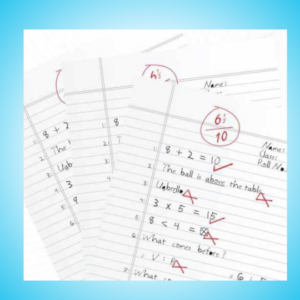

Pick subject, class, board, difficulty and marks. Get a complete paper with its answer key in seconds.
Introduction
A senior chemistry teacher at a college recently shared this with our team: she was spending three full weekends every semester just setting question papers.
Three weekends for one subject, for three classes. Multiply that by every teacher in every department, and you start to see the real cost of manual paper setting.
AI question paper generators flip that math. Upload your syllabus, pick your blueprint, and the system drafts a complete paper in under three minutes. You still review it, you still own the quality. But the mechanical work is gone.
This guide walks through exactly what these tools do, how they work in practice, what to watch out for, and how to choose one that fits your board, your question types, and your security needs.
What is an AI Question Paper Generator?
An AI question paper generator is an intelligent automated tool that uses artificial intelligence and machine learning algorithms to create examination questions, quizzes and complete test papers from your input content.
Unlike traditional methods where educators manually craft each question, AI-powered tools analyze your syllabus, textbooks, PDFs, or any educational content to generate relevant, curriculum-aligned questions instantly.
The newest platforms go further. They can generate questions from a recorded lecture, auto-transcribed, or from an entire textbook chapter by chapter. Scanned and even handwritten papers can be imported into the question bank, with diagrams cropped and attached automatically.
These advanced tools understand context, difficulty levels, and learning objectives to produce questions that accurately assess student knowledge.
Whether you need multiple-choice questions (MCQs), fill-in-the-blanks, short answers, essay questions, or case studies, an AI question paper generator can produce them within seconds.
Key Benefits of Using AI to Generate Question Papers

- Eliminate question paper leaks.
- Automate question paper creation process.
- Manage role-based access to define questions.
- Generate sets of question papers instantly.
AI vs Manual Question Paper Generation: Complete Comparison
| Traditional Question Bank | AI Question Paper Generator | |
|---|---|---|
| Role | Stores questions in folders | Stores AND assembles papers from them |
| Paper creation | Manual – teacher picks each question | Automatic – AI fills the blueprint |
| Unique sets | One paper per exam cycle | Up to 5+ unique sets in minutes |
| Classification | Manual tags by teacher | Auto-tagged by topic, Bloom, difficulty |
| Syllabus coverage | Gaps easy to miss | Coverage analysis flags gaps |
| Time to assemble | 3-4 hours for 50 MCQs | Minutes, not hours, for 50 MCQs |
| Error risk | Duplicate questions, missed topics | Duplicate detection built in |
| Export | Copy-paste to Word | Branded PDF, ready to print |
When to Use Each Approach
AI Question Paper Generation is Ideal For:
- Large-scale examinations (100+ students)
- Frequent testing (weekly quizzes, practice tests)
- Competitive exam preparation
- Remote/online assessments
- Quick revision assessments
- Mock tests and practice papers
Manual Creation May Be Preferred For:
- Highly specialized niche subjects
- Creative/subjective assessments
- One-time unique assessments
- Institutions without digital infrastructure
Cost-Benefit Analysis
Traditional Method (Annual Cost for a School):
- Teacher time: 400 hours x Rs.500/hour = Rs.2,00,000
- Printing/distribution: Rs.50,000
- Administration: Rs.30,000
- Total: Rs.2,80,000/year
AI-Powered Method (Annual Cost):
- AI tool subscription: Rs.50,000-80,000 (assumed licence cost for this model, not an Eklavvya quote)
- Training time: Rs.10,000
- Total: Rs.60,000-90,000/year
Annual Savings: Rs.1,90,000-2,20,000 (68-78% reduction)
Illustrative model for a mid-size school, based on the assumptions above. Actual figures vary with question-bank size, number of paper setters and whether secure printing is included.
Step-by-Step Guide: AI Question Paper Generator
Follow this proven 5-step process for optimal results:
Step 1: Draft
The paper setter opens QPGMS and picks a method – blueprint, sample paper, syllabus, or question bank. Choose the subject, unit, difficulty mix, and question types. AI assembles the draft in two to three minutes. The paper setter can replace any question, tweak marks, or add instructions – then save the draft.
Step 2: Submit
Once the draft feels right, the setter submits it for review. The submission triggers a notification to the assigned validator and locks the paper from further edits by the setter. A timestamp and version snapshot are stored, so everyone knows exactly which version was sent for review.
Step 3: Review
The validator opens the paper and goes question by question. They can leave comments on individual questions or on the paper as a whole, flag issues, and request changes. If the paper needs work, it goes back to the setter with specific feedback – not a vague “please revise”.
Step 4: Approve
When the validator is satisfied, they approve the paper. The approval is logged with a timestamp, the validator’s name, and any final comments. This audit trail matters – for RTI compliance, for quality reviews, and for the rare day when someone asks “who approved this question?”.
Step 5: Publish
Approved papers get locked, branded with the institute’s logo and watermark, and exported as print-ready PDFs. Multiple sets (Set A, Set B, Set C) export separately for secure distribution. Papers go out via OTP-based access and dual-login – no email attachments, no USB drives, no physical transport. Publishing freezes the paper as a tamper-proof, content-hashed snapshot. Every exported paper carries a QR code that anyone can scan to confirm it is genuine.
7 Ways to Generate Question Papers with AI
From your syllabus
Upload the syllabus as a PDF or Word file. The system extracts the topic list, then drafts questions against the topics you pick.
Best for: a new subject or a first paperFrom last year’s paper
Add a past paper alongside the syllabus. You get up to five complete sets matching its sections, marks, difficulty and Bloom mix, with entirely fresh questions.
Best for: matching an established house patternFrom a topic brief
Choose subject, topic, question type, difficulty and count, then add a one-to-three line description. Board and curriculum context, including competitive formats, can be set up front.
Best for: filling a specific gap fastFrom a passage you paste
Paste a passage of roughly 3,000 characters and file the output under any topic. Suited to comprehension and case-based questions.
Best for: case studies and comprehensionFrom a recorded lecture
Upload an audio or video lecture. It is transcribed automatically and questions are drawn from what was actually taught in class.
Best for: internal and course-aligned testsFrom a textbook or ebook
Upload a full book. The contents page is parsed, chapters are segmented and mapped onto your subject catalogue, then generated chapter by chapter in the background.
Best for: building a large bank fastFrom material you already have
A handwritten paper, a page of notes, a marked assignment or a scanned worksheet. OCR and vision read it with per-page confidence scores, you review the extracted text, and anything the source does not support is dropped.
Best for: turning paper records into new questionsAvailability differs by mode. Drafting from a syllabus, a topic brief or a passage is standard; lecture, ebook and uploaded-content generation are add-ons enabled per institute.
Every mode returns a complete question: stem, options, correct answer, explanation, difficulty, Bloom’s level and marks. Nothing enters your question bank until a person accepts it.
A second AI pass checks the first
After every batch an adversarial critic reviews each question for scope, ambiguity, factual soundness, answer leakage, marks and difficulty fit, and duplicates across sections.
For image questions it inspects the rendered figure itself, checking that the labels match the stem and that the answer is not drawn into the picture.
Defective items are rejected or regenerated before you see them, and the request detail reports what was actually delivered against what you asked for. It is a validation gate that rejects rather than guesses.
Question Types an AI Question Paper Generator Should Support
A generator is only as useful as the formats it can assemble. If your exam pattern mixes an objective section with descriptive answers, the tool has to handle both inside one blueprint – not force you to build two papers and staple them together.
| Objective questions | Subjective questions |
|---|---|
| Multiple choice (MCQ) | Brief answer |
| Fill in the blanks | Short answer |
| True or false | Long answer |
| Match the following | Case study / descriptive |
| Multiple response | Coding assessment |
Objective type questions are where AI generation pays off first. They are high volume, formulaic to write and tedious to vary – exactly the work that drains a paper setter’s weekend. A blueprint can specify, for example, 40 MCQs split 40/40/20 across easy, moderate and difficult, with no more than five questions drawn from any single unit, and the system will honour that distribution or warn you that the bank cannot satisfy it.
Descriptive questions still need judgement, but the generator handles the scaffolding: sub-questions, OR-logic (either/or choices within a section), section re-ordering and per-question marks. Institutes using formats outside this list can define custom question types and sub-question types rather than bending their paper pattern to fit the software.
Secure Paper Printing and Release
Most question paper leaks do not happen during generation. They happen in the gap between a finalised paper and the exam hall – a PDF emailed to a printer, a file sitting on a coordinator’s desktop, a WhatsApp forward sent “just to confirm the format”. Generation security means very little if the release stage is a shared folder.
This is the part of the workflow that changed most in the June-July 2026 release. The controls now follow the paper from the moment it is finalised to the moment it comes off the printer:
| Control | What it does |
|---|---|
| Lock and scheduled release | Freezes a finalised paper so it cannot be casually edited or exported, and releases it only at a set time, to specified printers. |
| Tamper-proof publishing | Publishing freezes the paper as an immutable, content-hashed snapshot. The paper that prints is provably the paper that was approved. |
| OTP-protected printing | The designated printer enters a one-time code to unlock a single, one-time download. Nothing can be re-pulled afterwards. |
| Copy quotas and per-copy logs | Each authorised printer works against a hard copy quota. Every printed copy is logged individually with copy number, operator and outcome. |
| Secure viewer with forensic watermark | Published papers open in a protected in-browser viewer carrying the institute logo and identifying marks, so a photographed leak traces back to a session. |
| Webcam capture at print | Optionally photographs the person at the moment of printing, as an audit record. |
| Live print proctoring | Monitor active print sessions from a dashboard and remotely terminate a suspicious one. |
| Admin dual-authorisation | Printing can require a second admin-approved OTP, so no single person can release a paper alone. |
| Print Operator role | A dedicated role with a “My Print Jobs” view and an automatic assignment email when rostered. |
| Secure Browser (SEB) printing | Final print can be locked to a secure browser that blocks other windows and second screens. |
| QR paper verification | Every exported paper carries a QR code. Anyone can scan it to confirm the paper is genuine, along with its subject, marks and status. Public page, no login required. |
Access to the system itself is hardened the same way: two-factor authentication (opt-in per user, enforceable by role), single sign-on through Microsoft, Google, Okta or SAML, allowed networks restricting sign-in to trusted campus IP ranges, authorised devices so only admin-approved machines can log in, and approved email domains with an exception queue – enforced on bulk imports as well as individual sign-ups.
Combine that with multi-set generation and the leak calculus changes. If five unique sets exist and the centre only learns which one is live at release time, a single compromised paper stops being an exam-cancelling event. For how this played out at national scale, see our analysis of secure question paper generation after the NEET 2026 leak.
Governance, Moderation and Audit Trails
The objection most exam cells raise about AI generation is not accuracy. It is accountability: if a bad question reaches the paper, who approved it? That question gets asked during NAAC, NBA and OBE audits, and “the system generated it” is not an answer.
Four mechanisms close that gap:
- Question moderation. New, imported and AI-generated questions route through an approve/reject step before they can be used, handled by a dedicated Moderator role. Nothing the AI produces enters the live bank until a person signs it off.
- Never-repeat generation. An “exclude previously-used questions” option skips anything already used, with a configurable look-back scope and a low-stock warning when the bank is running thin against your blueprint.
- An audit trail that names names. Every logged action records the real person, their role, the action, the timestamp and the IP address, filterable by area. Not “user 47 edited a question” but a record you can hand an auditor.
- Examiner-side proctoring. Sensitive work sessions for paper setters and validators can be recorded: identity photo, webcam and screen capture, and integrity-event logging, with live monitoring and full replay. External examiners can be restricted to a workspace that shows only their assigned syllabus scope, with no PDF download.
The approval workflow itself is a state machine – draft, submitted, under review, approved or rejected, published – with a request-changes loop, threaded comments and full approval history across three working roles: Admin, Paper Setter and Validator.
Blueprint drift is handled the same way. Because the blueprint declares the marks split, difficulty mix and Bloom’s or Course Outcome distribution up front, the coverage report shows whether the final paper actually matched what was declared – which is the evidence an OBE audit asks for. Course Outcome mapping can be made mandatory per question. A CO-by-Bloom distribution matrix, with action-verb validation that checks whether a question opens with a verb matching its declared Bloom level, gives NBA and NAAC reviewers a ready-made report. The same discipline applies to the bank feeding it; see our question bank management system guide.
Security and Compliance: What to Ask a Vendor
Question papers are among the most sensitive data an institution holds. Before shortlisting any AI question paper generator, ask for the following in writing. For reference, these are the commitments the Eklavvya question paper platform operates under:
| Parameter | Commitment |
|---|---|
| Certifications | CERT-IN certified for software security; ISO/IEC 27001:2013 |
| Recovery time objective (RTO) | 4 hours, via standby-server failover |
| Recovery point objective (RPO) | Near-zero (0-5 minutes), with point-in-time restore |
| Uptime SLA | 99.5% contracted, publicly monitored |
| Backups | Automated daily, weekly and monthly, plus 12 rolling monthly archives |
| Retention | 2-3 years and above, configurable |
| Security testing | Black-box on every major release; annual penetration test and vulnerability assessment; SAST and DAST |
| Application security | 2FA, JWT authentication, role-based access control, IP-restricted database, OWASP Top 10 code review |
| Data ownership | The institution owns all data. Full export (CSV, XLSX, PDF) within 30 days of termination, then secure purge with deletion confirmation |
| Hosting | Deployable on AWS, Azure, DigitalOcean or private cloud; on-premise friendly |
| Support | Email, phone, WhatsApp and ticketing. High-priority resolution in 2-3 hours |
Two of these matter more than institutions usually expect. Data ownership and exit terms decide whether your question bank is portable or hostage – a bank built over five years is an asset, and you should be able to walk out with it. And deployment portability determines whether a state examination body with data-residency rules can use the platform at all.
You can walk through generation, review and secure release end to end on the question paper generation platform, or explore the bank side on the AI question bank generator.
Common Challenges and How to Fix Them
| Challenge | Why It Happens | Practical Fix |
|---|---|---|
| AI generates awkwardly worded questions | Training data is generic, not tuned to your board or style | Upload 2-3 sample papers. AI learns your phrasing and matches it. |
| Difficulty labels feel off | “Medium” for AI may be “easy” for your students | Calibrate on 10-15 questions you know well. Adjust labels once – it holds. |
| Math equations break in PDF | Platform is not using proper math rendering | Pick a platform with LaTeX or MathML output (QPGMS has this built in). |
| Questions repeat from last semester | No duplicate detection against paper history | Use a platform with duplicate detection. QPGMS flags repeats automatically. |
| Board-specific conventions missing | Generic AI does not know “Section A: 1 mark each, attempt any 10 out of 12” | Define the blueprint once with these rules. AI enforces them every time. |
| Teachers worried about job security | Framing issue – AI is positioned as a replacement | Position AI as a time-saver for teachers, not a replacement. Run a demo with the faculty. |
| Data privacy concerns | Unclear where questions are stored | Pick a platform with per-institute data isolation, role-based access, and audit logs. |
Case Study: Leading Medical University
A Leading Medical University: From 3-Day Paper Setting to 30 Minutes
The university conducts internal assessments, mid-semester exams, and final exams for 5,000+ students across MBBS, BDS, and paramedical programs. Each exam cycle required 30+ subject experts setting papers across 80+ subjects – consuming weeks of faculty time per semester.
- Eliminate question paper leaks.
- Automate question paper creation process.
- Manage role-based access to define questions.
- Generate sets of question papers instantly.
Frequently Asked Questions
Conclusion: The Future of Assessment Creation
The way exam papers get made is quietly changing. Ten years ago, setting a good paper was an art – slow, manual, and entirely dependent on the paper setter’s experience and energy.
Today, the art is still there, but the mechanical work is disappearing. The paper setter defines the blueprint; AI assembles the draft; the teacher reviews and approves. Everyone’s time gets used where it matters most.
AI question paper generators are not about replacing teachers. They are about returning the weekends every teacher loses to paper assembly – so that time can go back into teaching, mentoring, and designing better learning experiences. The tools are mature. The case studies are real. The ROI arrives in the first semester.
If you are still setting papers the old way, the question is not whether AI paper generation will come to your institute. It is whether you will adopt it on your timeline with careful evaluation, a good trial, and faculty buy-in, or wait until a competitor across town starts giving teachers their weekends back first.