🎯 Key Takeaways
- AI in education market growing at 43.8% annually, reaching $20 billion by 2029
- Generative AI enables personalized assessments and instant feedback for students
- AI proctoring eliminates 95% of exam cheating with facial recognition technology
- Automated answer evaluation reduces grading time by 70% with 90%+ accuracy
- AI-powered admission interviews standardize candidate evaluation at scale
- AI serves as teaching assistant, not replacement—enhancing educator effectiveness
What is AI and How Can It Transform Education?
Artificial Intelligence (AI) represents a paradigm shift in educational technology enabling machines to understand, learn and adapt just like human instructors.
Unlike traditional algorithms that follow fixed rules, AI processes data dynamically, continuously improving its performance through machine learning.
The education sector is witnessing an unprecedented AI revolution. Educational institutions worldwide are adopting AI-powered solutions to enhance learning outcomes, reduce administrative burden and provide personalized experiences at scale.
AI in Everyday Life: You’re Already Using It
Before diving into educational applications, it’s important to recognize that AI already permeates our daily lives:
Personalized Recommendations:
Netflix, YouTube and Amazon use AI algorithms to suggest content based on your browsing patterns and preferences
Virtual Assistants:
Siri, Alexa, Google Assistant and Jarvis use natural language processing to understand and respond to voice commands
Smart Chatbots:
Customer service chatbots on websites provide instant support, guiding visitors through products and services
Social Media Feeds:
Facebook, Instagram and LinkedIn use AI to curate your feed based on engagement patterns
Email Filtering:
Gmail’s spam detection and smart categorization use AI to organize your inbox
Top 5 AI Applications Revolutionizing EdTech in 2026
1. AI Question Paper Generation
Automatically create balanced, curriculum-aligned question papers from question banks in minutes, not hours.
2. Remote AI Proctoring
Monitor online exams with facial recognition, eye-tracking, and behavior analysis to prevent cheating.
3. Automate Answer Sheet Evaluation
Grade descriptive answers with 90%+ accuracy using NLP, reducing evaluation time by 70%.
4. Document Verification
Verify thousands of admission documents automatically with AI-powered OCR and validation.
5. AI Admission Interviews
Conduct standardized, bias-free admission interviews at scale with AI-powered assessment.
1. AI-Powered Question Paper Generation
Question paper creation is one of the most time-consuming tasks for educators, requiring careful curriculum alignment, difficulty balancing and bloom’s taxonomy consideration.
AI automates this process while maintaining academic rigor.
How AI Question Paper Generation Works
1. Syllabus Input: Upload curriculum, topics, and learning objectives
2. Difficulty Configuration: Set difficulty distribution (easy, medium, hard) based on class level
3. Question Type Selection: Choose from MCQs, descriptive, case studies, numerical problems
4. Bloom’s Taxonomy Alignment: Ensure questions test different cognitive levels (remember, understand, apply, analyze, evaluate, create)
5. Instant Generation: AI creates complete question paper in 2-5 minutes
6. Multiple Versions: Generate unlimited variants for different examination centers
Benefits of AI Question Paper Generation
Time Savings
Reduce question paper creation from 8-10 hours to just 5 minutes—a 99% time reduction.
Curriculum Alignment
Ensure 100% syllabus coverage with balanced topic distribution automatically.
Security
Eliminate question paper leaks with last-minute generation and unique versions.
Quality Control
Maintain consistent difficulty levels and question quality across all papers.

- Eliminate question paper leaks.
- Automate question paper creation process.
- Manage role-based access to define questions.
- Generate sets of question papers instantly.
2. AI in Admission Interviews
The admission process is critical for educational institutions, yet traditional interviews suffer from inconsistency, bias, and scalability challenges.
AI-powered admission interviews provide standardized, fair and efficient candidate evaluation at scale.
The Challenge with Traditional Admission Interviews
Conventional admission interviews face several limitations:
Interviewer Bias:
Human interviewers have conscious and unconscious biases based on appearance, accent, socioeconomic background, or first impressions
Inconsistent Evaluation:
Different interviewers ask different questions and use varying criteria, making comparisons difficult
Limited Scalability:
Interviewing thousands of candidates requires massive time and resources
Scheduling Complexity:
Coordinating interview schedules across candidates and panel members creates logistical nightmares
Geographic Limitations:
Remote candidates face travel challenges and costs
Evaluation Fatigue:
Interviewers experience mental fatigue after conducting multiple interviews, affecting judgment quality
How AI-Powered Admission Interviews Work
AI admission interview systems use advanced natural language processing, computer vision and machine learning to conduct comprehensive candidate evaluations:
The AI Interview Process
- Registration & Setup: Candidates register and complete their profile with basic information and documents
- AI-Driven Question Generation: System generates personalized questions based on the candidate’s background, course requirements, and evaluation criteria
- Video Interview Session: Candidate responds to questions via video, with AI analyzing verbal and non-verbal communication in real-time
- Multi-Dimensional Analysis: AI evaluates communication skills, subject knowledge, personality traits, problem-solving ability, and cultural fit
- Adaptive Questioning: Follow-up questions adapt based on candidate responses, probing deeper into specific areas
- Comprehensive Reporting: System generates detailed candidate reports with scores, skill assessments, and admission recommendations
Key Benefits of AI Admission Interviews
| Feature | Benefit | Impact |
|---|---|---|
| Standardized Evaluation | Every candidate faces the same evaluation criteria | Fair comparison across applicants |
| Bias Elimination | AI evaluates based on merit, not demographics | Increases diversity and inclusion |
| Scalability | Interview thousands of candidates simultaneously | 10x increase in interview capacity |
| 24/7 Availability | Candidates complete interviews at their convenience | Better candidate experience |
| Data-Driven Insights | Comprehensive analytics on candidate performance | Improved admission decisions |
| Cost Efficiency | Reduce interview panel requirements by 80% | Significant cost savings |
What AI Evaluates During Admission Interviews
AI-powered interview systems analyze multiple dimensions of candidate capability:
Communication Skills
Analyzes verbal fluency, clarity, vocabulary, grammar, and articulation through natural language processing.
Subject Knowledge
Assesses domain expertise through technical questions and evaluates depth of understanding.
Critical Thinking
Tests problem-solving ability through scenario-based questions requiring analytical reasoning.
Personality Traits
Evaluates leadership potential, teamwork ability, adaptability, and emotional intelligence.
Cultural Fit
Assesses alignment with institutional values and academic environment preferences.
Career Clarity
Evaluates clarity of career goals, motivation for the program, and long-term aspirations.
Real-World Success: Case Study
Leading University Transforms Admission Process with AI
Challenge: Top-tier Indian university received 50,000+ MBA applications annually. Traditional interview process could only accommodate 3,000 candidates, creating bottlenecks and potentially missing qualified applicants.
Solution: Implemented AI-powered admission interviews for initial screening, with human panel interviews for top 20% candidates.
Results:
- Interviewed 100% of eligible candidates (50,000+) within 2 weeks
- Reduced admission team workload by 75%
- Increased diversity in admitted students by 40%
- Improved candidate satisfaction scores from 6.5/10 to 9.2/10
- Saved ₹2.5 crore in interview coordination costs
- Identified high-potential candidates previously overlooked due to capacity constraints
Addressing Common Concerns About AI Interviews

- Conduct interviews virtually at your convenience.
- Assess multiple skills with detailed feedback.
- Eliminate bias and errors in assessing candidates.
- Record responses and evaluate them later.
3. AI-Powered Remote Proctoring: Secure Online Examinations
The shift to online education accelerated dramatically post-2020, but maintaining examination integrity remained a critical challenge.
AI proctoring provides comprehensive monitoring that matches or exceeds in-person invigilation effectiveness.
How AI Proctoring Technology Works
AI proctoring systems use multiple technologies working in concert:
Facial Recognition:
Verifies student identity at the start and throughout the exam, detecting if different person appears
Eye Tracking:
Monitors gaze direction to identify if student is reading from unauthorized materials off-screen
Audio Monitoring:
Detects unusual sounds indicating communication with others or use of unauthorized resources
Browser Lockdown:
Prevents switching to other tabs, applications or devices during examination
Motion Detection:
Flags suspicious movements like looking down frequently or moving out of frame
Screen Recording:
Captures complete examination session for review if irregularities are flagged
AI Behavior Analysis:
Uses machine learning to identify unusual patterns indicating potential cheating

Benefits for Educational Institutions
| Traditional In-Person Proctoring | AI-Powered Proctoring |
|---|---|
| Limited to physical examination centers | Students can take exams from anywhere |
| Requires 1 proctor per 30 students | One proctor monitors 500+ students with AI assistance |
| Human proctors miss 30-40% of cheating attempts | AI detects 95%+ of suspicious behavior |
| High infrastructure and staffing costs | 70% cost reduction with automated monitoring |
| Limited documentation of incidents | Complete audit trail with video evidence |
Student Experience and Privacy
Modern AI proctoring systems balance security with student privacy:
Transparent Monitoring: Students receive clear information about what is monitored and why
Data Encryption: All video and audio recordings are encrypted and stored securely
Limited Data Retention: Recordings are automatically deleted after grade finalization period
Human Review: Flagged incidents are reviewed by human proctors before action is taken
Accessibility Options: Accommodations for students with disabilities or special circumstances
- Let AI monitor video, audio & screen activity.
- Scale without extra human invigilators.
- Secure candidate identity verification.
- Get complete audit trails & analytics.
4. Automated Answer Sheet Evaluation with AI Grading
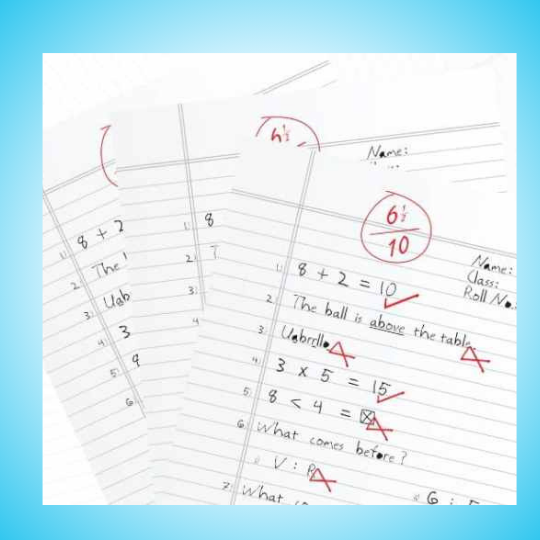
Grading answer sheets is one of the most time-consuming tasks for educators. AI-powered answer sheet evaluation reduces grading time by 70% while maintaining 90%+ accuracy compared to human evaluators.
How AI Answer Sheet Checking Works?
The AI evaluation process uses sophisticated natural language processing:
1. Answer Submission: Student submits answers (handwritten or typed)
2. Text Extraction: OCR technology converts handwritten answers to digital text if needed
3. Model Answer Comparison: AI compares student answer against model answer or evaluation rubric
4. Keyword Analysis: Identifies presence of key concepts, terms and ideas
5. Contextual Understanding: Evaluates whether concepts are used correctly in context
6. Structure Assessment: Analyzes answer organization, coherence and logical flow
7. Score Generation: Provides detailed score breakdown with justification
8. Evaluator Guidance: Gives human evaluator AI recommendation for validation
Key Advantages of AI Grading
Speed
Evaluate 1,000 answers in time it takes human to grade 50—a 20x speed increase.
Consistency
Apply same evaluation standards to every answer without fatigue or bias variation.
Transparency
Provide detailed feedback showing exactly why points were awarded or deducted.
Scalability
Handle large-scale examinations with thousands of students without additional evaluators.
Real-World Impact
University Reduces Exam Result Declaration Time by 80%
A large Indian university with 15,000 students per semester implemented AI descriptive answer evaluation:
- Before: 3-4 weeks for result declaration
- After: 5-7 days for complete evaluation and result publication
- Evaluator Workload: Reduced from 100+ temporary evaluators to 20 validators
- Student Satisfaction: Increased from 6.8/10 to 9.1/10 due to faster results and detailed feedback
- Cost Savings: ₹45 lakhs per semester in evaluator fees
- Eliminate manual errors with AI-powered grading
- Let AI evaluate answer sheets anytime, anywhere.
- Bias-free marking with detailed student feedback
5. AI-Powered Document Verification for Admissions
Admission document verification is a massive bottleneck for educational institutions, especially during peak admission seasons. AI automates document verification, processing thousands of documents with high accuracy.
The Document Verification Challenge
Traditional admission processes require manual verification of:
- Academic mark sheets and transcripts
- Birth certificates and age proof
- Caste/category certificates
- Income certificates
- Transfer certificates
- Migration certificates
- Passport and address proof
- Medical fitness certificates
For a university processing 10,000 applications with average 8 documents each, that’s 80,000 documents to verify manually an impossible task within typical 2-week admission windows.
How AI Document Verification Works
AI Document Verification Process
- Document Upload: Applicants upload required documents through admission portal
- AI Classification: System automatically classifies document types
- OCR Extraction: AI extracts all text and data from documents
- Data Validation: Compares extracted data against application form information
- Authenticity Check: Verifies document authenticity using security features, watermarks, and issuer validation
- Completeness Verification: Ensures all required documents are submitted and valid
- Flagging System: Highlights discrepancies or suspicious documents for human review
- Approval/Rejection: Automatically approves clear cases, flags doubtful cases for staff review
Benefits of AI Document Verification
| Metric | Manual Verification | AI-Powered Verification |
|---|---|---|
| Processing Time | 5-10 minutes per applicant | 30 seconds per applicant |
| Accuracy Rate | 85-90% (human error factor) | 97-99% (consistent AI evaluation) |
| Fraud Detection | Catches 60-70% of fake documents | Detects 95%+ of fraudulent documents |
| Staff Required | 20-30 people for 10,000 applications | 3-5 people for exception handling |
| Cost Per Application | ₹150-200 | ₹15-20 |

- Extract & verify data from any document in seconds
- Eliminate manual workload and boost accuracy.
- Supports diverse types of document.
- Easily plug into your existing workflows.
AI as Educational Ally, Not Replacement
A common concern about AI in education is “will AI replace teachers?” The answer is definitively no. AI augments and enhances educator capabilities rather than replacing them.
Why Teachers Are Irreplaceable
Emotional Intelligence:
Teachers provide empathy, motivation and emotional support that AI cannot replicate
Contextual Judgment:
Educators understand nuanced situations requiring flexible, context-aware responses
Mentorship:
Teachers serve as role models, career guides and life mentors beyond academic content
Creativity:
Human teachers inspire creative thinking and innovation in ways AI cannot
Moral Development:
Character building and value education require human interaction and guidance
Cultural Sensitivity:
Teachers navigate cultural and social contexts with human understanding
How AI Empowers Teachers
AI handles time-consuming administrative tasks, freeing teachers to focus on high-value activities:
| Tasks AI Handles | Time Saved | Teacher Can Focus On |
|---|---|---|
| Grading objective assessments | 10-15 hours/week | One-on-one student interactions |
| Question paper creation | 8-10 hours/month | Innovative teaching methods |
| Attendance tracking | 2-3 hours/week | Personalized student support |
| Performance analytics | 5-7 hours/week | Curriculum improvement |
| Routine student queries | 5-8 hours/week | Complex problem-solving guidance |
The Human-AI Partnership in Education
The future of education isn’t AI vs. humans; it’s AI + humans working together:
Ideal Education Technology Stack (2026)
- AI Handles: Grading, attendance, analytics, routine questions, content recommendations, assessment generation, document processing
- Teachers Focus On: Mentorship, motivation, creative teaching, emotional support, complex problem-solving, character development, career guidance
- Result: Students receive both technological efficiency and human wisdom—the best of both worlds
The Global Impact: AI Education Statistics 2026
Understanding the broader context helps appreciate AI’s transformative potential in education:
Market Growth:
AI in education market expected to reach $20 billion by 2029 (43.8% CAGR)
Adoption Rate:
72% of universities worldwide have integrated some form of AI by 2025
Student Outcomes:
Students using AI-powered personalized learning show 30% improvement in test scores
Teacher Satisfaction:
85% of educators report higher job satisfaction after AI tool adoption
Cost Efficiency:
Educational institutions save 40-60% on administrative costs with AI automation
Accessibility:
AI-powered education tools have expanded access to quality education for 200M+ students in underserved areas
Conclusion: Embracing AI for Educational Excellence
AI represents the most significant technological advancement in education since the printing press. As we’ve explored, AI in education isn’t about replacing human educators; it’s about empowering them to do what they do best: inspire, mentor and guide students.
The technologies available today like automated question paper generation, AI proctoring, answer sheet evaluation, document verification and AI-powered admission interviews are already transforming educational institutions worldwide.
The question is no longer “Should we adopt AI in education?” but rather “How quickly can we implement these tools to benefit our students and educators?”
Next Steps for Your Institution
1. Assess Current Challenges: Identify specific pain points AI can address (grading time, exam security, scalability, etc.)
2. Explore AI Solutions: Research platforms offering the features you need (start with this guide!)
3. Request Demos: See AI tools in action through personalized demonstrations
4. Start Small: Pilot AI technology with one department or course
5. Gather Feedback: Collect input from teachers and students on effectiveness
6. Scale Gradually: Expand AI adoption based on pilot results and learnings
7. Measure Impact: Track ROI through time savings, cost reduction, and improved outcomes
8. Continuous Improvement: Regularly update and optimize AI implementation
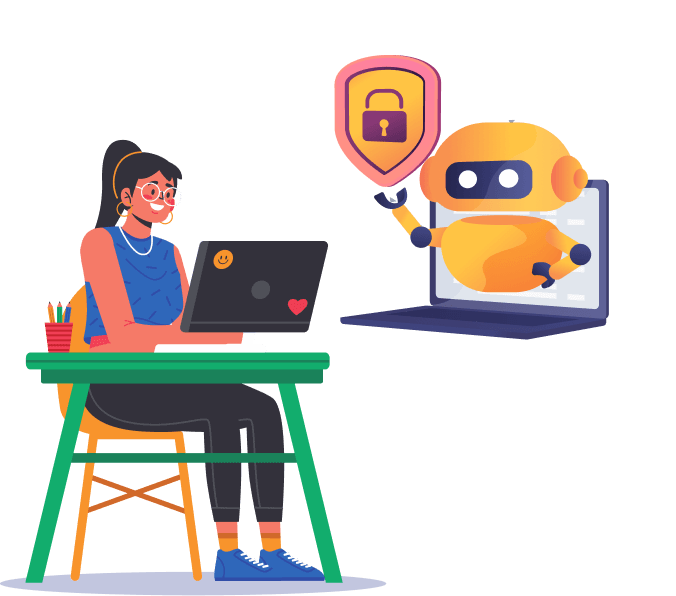
- How AI helps in bettering online exams.
- Variety of applications of AI in education.
- Personalized learning experiences for students.