
AI’s Growing Influence on Student Learning
Last semester, a seasoned high school literature teacher in Mumbai noticed something odd.
One of her quietest students had turned in an excellently written essay on Shakespeare’s Macbeth, free of grammatical errors, flawlessly structured and devoid of any personal voice.
Curiously, she copied a paragraph into an AI detection tool. The result? A 97% likelihood that the essay was written by artificial intelligence.
This wasn’t an isolated incident; it was a sign of a much larger shift.
From London to Lisbon, educators are witnessing a quiet revolution, as the AI impact on education is no longer a futuristic concept but a present-day reality.
Artificial intelligence has seamlessly integrated into the educational landscape.
Smart tutoring systems, AI-powered research assistants and generative AI that can draft entire essays are redefining how students learn, complete assignments and even think.
The artificial intelligence impact on students is undeniable, but as these tools grow more sophisticated, a critical question emerges: Are we fostering a generation of innovators or simply proficient operators?
AI in the Classroom: The New Normal in Education
The adoption of AI in education has accelerated at an unprecedented rate.
A 2024 survey by Study.com revealed that over 60% of U.S. college students have used ChatGPT for their schoolwork.
This trend is not confined to the United States; a recent UNESCO report highlights similar adoption rates in the United Kingdom, Germany and several Asian countries, underscoring the global nature of the AI impact on student learning.
Tools like Grammarly, Turnitin’s AI writing detection and AI-powered coding assistants have become as commonplace as calculators were three decades ago.
On the surface, this represents a significant leap forward.
Students struggling with language barriers can instantly polish their grammar, while those with learning disabilities can receive personalized instruction tailored to their unique needs.
The potential for AI to level the academic playing field is one of its most celebrated benefits.
However, the line between supporting learning and substituting effort is becoming increasingly blurred. This distinction is at the heart of the debate surrounding the impact of artificial intelligence on students.
Further Readings
- Top 10 AI Tools for Education Content Creation for 2026
- Top 31 AI EdTech Tools That Are Changing Education in 2026
- Best Generative AI Tools for Education in 2026
Benefits and Risks of AI in Education
To fully grasp the AI effect on critical thinking, it is essential to weigh the advantages and disadvantages of its integration into the educational ecosystem.
| Feature | Benefits | Risks |
|---|---|---|
| Personalized Learning | AI algorithms can adapt to individual student paces, offering customized learning paths and targeted support. | Over-reliance can create learning bubbles, limiting exposure to diverse perspectives and challenging materials. |
| Enhanced Efficiency | Students can automate tedious tasks like proofreading and data collection, freeing up time for higher-order thinking. | The temptation to automate complex tasks can lead to a decline in foundational skills like research and writing. |
| Accessibility | AI tools can provide real-time translation, text-to-speech and other accommodations for students with disabilities. | Unequal access to premium AI tools can exacerbate existing educational inequalities. |
| Information Access | AI can quickly synthesize vast amounts of information, providing students with a starting point for research. | AI-generated summaries may lack nuance, contain biases or even present misinformation as fact. |
Is AI Eroding Critical Thinking?
Imagine being able to type, “Write a 1,000-word analysis of the socio-economic impact of the Industrial Revolution,” and receiving a comprehensive draft in seconds.
This is the power of modern generative AI and it presents a significant challenge to traditional education.
The negative effects of AI on students in 2026 are a growing concern for educators worldwide, as the convenience of these tools may come at a steep price.
The more students rely on AI to generate answers, the less they engage in the cognitive processes that are essential for genuine learning.
Instead of grappling with complex topics, formulating arguments and synthesizing information, some students are simply outsourcing their thinking to an algorithm.
A 2024 Chegg survey found that over 30% of students using AI felt less confident in their ability to write essays without assistance, a clear indicator of declining self-efficacy.
This trend is not just about a lack of confidence; it has a measurable AI impact on students’ critical thinking skills.
When students bypass the struggle of the learning process, they miss the opportunity to build the mental resilience and analytical skills that are crucial for academic and professional success.
The long-term artificial intelligence changing the landscape is a topic of intense debate, with many experts fearing a future where students are adept at using tools but deficient in the ability to think for themselves.
Why Critical Thinking is the Most Important Skill in the Age of AI?
Critical thinking has always been a cornerstone of education, but in an era dominated by artificial intelligence, its importance has magnified tenfold.
It is the fundamental skill that allows us to navigate a complex world, to distinguish between credible information and sophisticated misinformation and to solve problems that don’t have a pre-programmed answer.
The AI classroom integration student benefits are only fully realized when students are equipped with the ability to think critically alongside these powerful tools.
Employers consistently rank critical thinking as one of the most sought-after soft skills.
A 2025 report from the World Economic Forum identified analytical thinking and creativity as the top two skills required for the future workforce.
As AI automates routine tasks, the demand for individuals who can ask insightful questions, evaluate information from multiple perspectives and make reasoned judgments will only continue to grow.
The educational technology AI student outcomes are not just about grades; they are about preparing students for a future where adaptability and intellectual agility are paramount.
Furthermore, in a digital landscape rife with deepfakes, algorithmic bias and echo chambers, the ability to think critically is a vital component of digital citizenship.
The student performance AI technology effects are not limited to academic assignments; they extend to how students perceive and interact with the world around them.
Teaching students to question the output of an AI, to consider its potential biases and to seek out diverse sources of information is no longer just good pedagogy; it is an essential life skill.
Strategies for Healthy Integration: A Guide for Educators and Parents
The challenge is not to ban AI, but to harness its power responsibly.
The how does AI impact student learning debate is nuanced and the solution lies in a balanced approach that prioritizes critical thinking and intellectual engagement.
Here are four actionable strategies for fostering a healthy AI integration in education:

1. Teach AI Literacy Beyond the Basics
It is no longer sufficient for students to simply know how to use AI; they must also understand how it works.
This means demystifying the technology, from the data it is trained on to the algorithms that power its responses.
A student who uses an AI to summarize a historical event without understanding that the AI might omit crucial context or perpetuate historical biases is at a significant disadvantage.
AI literacy involves teaching students to critically evaluate AI-generated content.
Is the source of the information reliable?
Are there any underlying biases in the response?
Is there a crucial nuance that the AI has missed?
Schools and universities should integrate modules on algorithmic bias, digital misinformation and the ethical boundaries of AI use.
This will empower students to use AI as a sophisticated tool for thinking, not a crutch that thinks for them.
2. Design Thoughtful Assignments That Outsmart AI
If an assignment can be completed with a single copy-paste prompt, it is likely not challenging students at a high enough level.
Educators can and should design assessments that require genuine human intellect, creativity, and personal reflection. These include:
In-class debates and Socratic seminars require students to think on their feet and defend their positions in real-time.
Personal narratives and reflective essays that connect course material to lived experiences.
Complex, multi-stage group projects that demand collaboration, original problem-solving, and project management skills.
Oral and viva examinations assess a student’s depth of understanding and ability to answer spontaneous questions.

- Conduct Assessments at your Time and Comfort.
- Comprehensive Language Proficiency Evaluation
- Conduct Hundreds of Concurrent Assessments.
- Eliminate the Need for Conducting Assessments In-Person
By designing assignments that AI cannot easily replicate, educators can ensure that students remain mentally engaged and invested in the learning process.
3. Encourage Process Over Product Making Thinking Visible
Traditional education has often placed a heavy emphasis on the final product: the essay, the exam score, the final grade.
This model, however, incentivizes shortcut-seeking, and with the advent of powerful AI tools, that shortcut has become shorter than ever.
Instead, educators can shift the focus to the process of learning. This might involve:
Requiring multiple drafts, outlines and annotated bibliographies.
Asking students to keep a learning journal where they reflect on their challenges and breakthroughs.
Incorporating peer reviews and collaborative brainstorming sessions.
This process-oriented approach not only mitigates the misuse of AI but also cultivates valuable lifelong habits such as perseverance, self-assessment and metacognition.
It makes the act of thinking visible and valuable.
4. Leverage AI for Support, Not Substitution
AI is not the enemy; it is a powerful tool that can either augment or atrophy our intellectual capabilities, depending on how it is used.
The key is to teach students to use AI with intentionality. Here’s what a balanced approach looks like in practice:
A student uses ChatGPT to brainstorm potential essay topics, but then conducts their own research and writes the essay in their own voice.
Grammarly is used to flag potential grammatical errors, but the student makes the final revisions based on their own judgment and the teacher’s feedback.
An AI research assistant is used to find relevant articles, but the student critically evaluates each source for credibility and relevance.
The central question students should be taught to ask is: “Am I using this tool to help me learn, or to avoid learning?”
By modeling this kind of metacognitive reflection, educators can help students develop the healthy habits necessary to thrive in an AI-driven world.
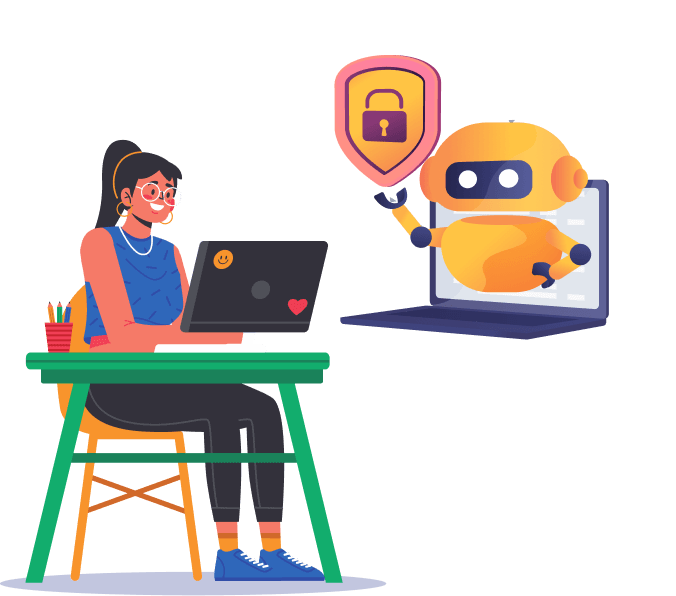
- How AI helps in bettering online exams.
- Variety of applications of AI in education.
- Personalized learning experiences for students.
Explore Deep Dives
- The Impact of AI on Higher Education Learning and Teaching
- The Future of Learning: Generative AI’s Role in Education in 2026
- Teachers: Meet AI – The Future of Education Support is Here
Navigating the Future of Learning in the Age of AI
Artificial intelligence is not a fleeting trend; it is a fundamental shift in the technological landscape, and its impact on education will only continue to grow.
Used thoughtfully, AI has the potential to make learning more accessible, efficient and personalized than ever before.
It can empower students with disabilities, provide personalized support to those who are struggling and automate tedious tasks, freeing up valuable time for deeper learning.
However, if we allow students to passively offload their intellectual labor to machines, we risk cultivating a generation that is technologically proficient but intellectually disengaged.
As educators, parents and lifelong learners, our mission is not to resist this change, but to guide it. We must teach our students not just to use AI, but to outthink it.
In a world where answers are instantaneous, the real power lies not in finding the answer, but in asking the right questions.
The future of education will be defined by our ability to foster this spirit of critical inquiry, to cultivate creativity, and to champion the uniquely human skills that no algorithm can replicate.