
Introduction
The world is witnessing an unprecedented wave of technological advancement. Artificial intelligence (AI) is at its forefront, reshaping industries across the globe.
Higher education is no exception to this transformation. The statistics are compelling.
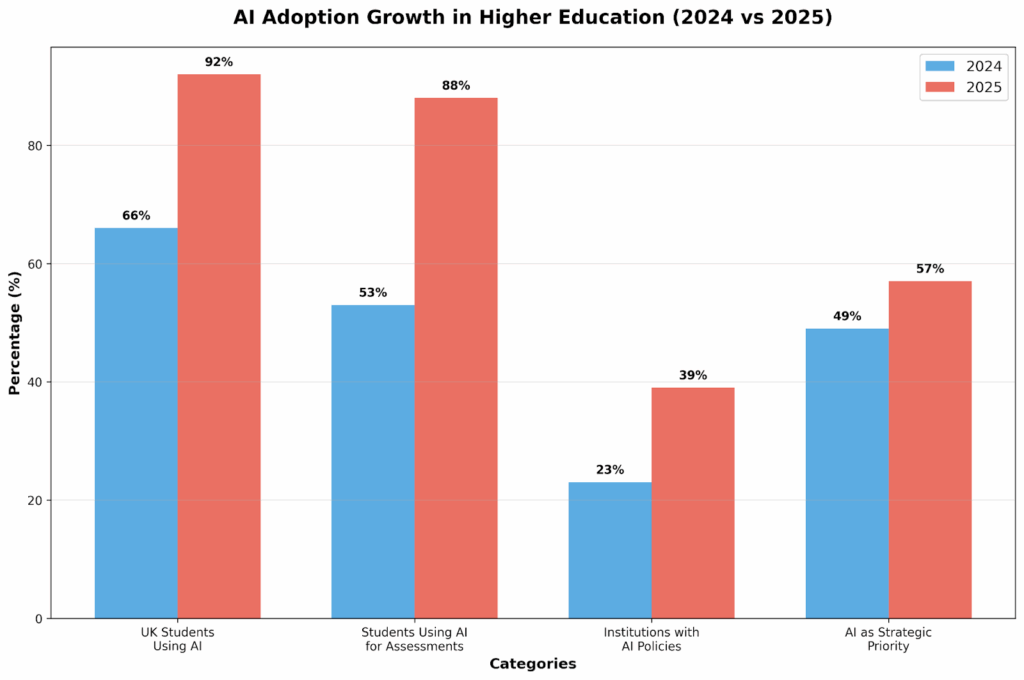
92% of UK students now use AI in some form. This represents a dramatic surge from just 66% in 2024.
Anara
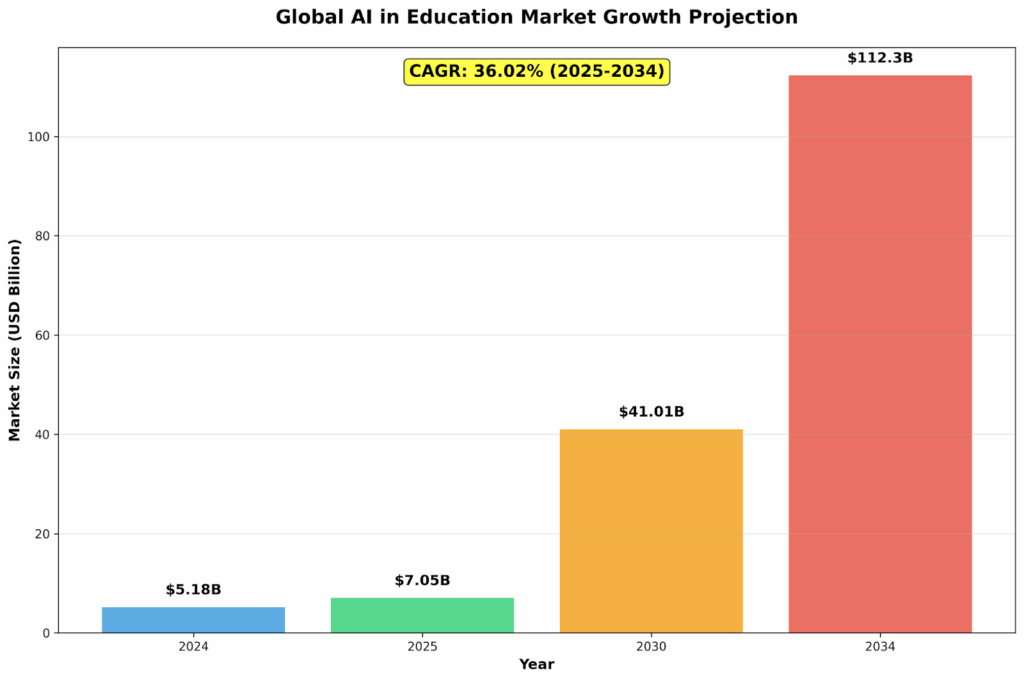
The global AI in education market tells an even more striking story.
It’s projected to grow from USD 7.05 billion in 2025 to a staggering USD 112.30 billion by 2034. This reflects a compound annual growth rate of 36.02%.
Precedence Research
This rapid adoption isn’t merely a trend. It’s a fundamental shift in how educational institutions operate.
From streamlining administrative tasks to personalizing learning experiences, AI is revolutionizing higher education at an unprecedented scale.
Recent surveys reveal that 86% of students globally use AI in their studies. Among these, 54% use it weekly and 25% use it daily.
In this comprehensive analysis, we’ll explore the multifaceted impact of AI on higher education and examine the remarkable potential it holds for the future of learning.
The Current State of AI Adoption in Higher Education
The numbers tell a compelling story about AI’s rapid integration into academic life.
According to the latest research, 88% of students have used generative AI for assessments. This marks a substantial increase from 53% in 2024.
This explosive growth has prompted institutions to respond strategically. 57% of institutions now consider AI a strategic priority, up from 49% the previous year.
However, this rapid adoption comes with challenges. AI-related academic misconduct has shown alarming growth.
Incidents increased from 1.6 students per 1,000 in 2022-23 to 7.5 students per 1,000 in 2024-25. This represents a nearly 400% increase.
This has led to increased policy development. 39% of institutions now have AI-related acceptable use policies, growing from 23% the previous year.
Automating and Simplifying Admission Interviews
The traditional university admissions process has long been resource-intensive and subjective.
Scheduling and conducting thousands of interviews manually creates significant bottlenecks. Inherent human biases can lead to inconsistent and unfair evaluations.
AI-powered interview platforms are emerging as a powerful solution. They offer a more efficient, scalable, and equitable approach to admissions.
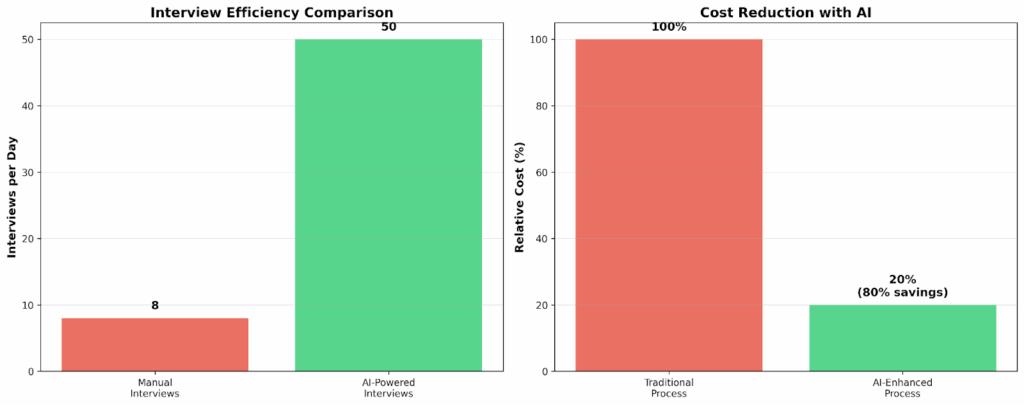
Modern AI interview systems can conduct 40-60 interviews per day compared to 8-10 manually. This represents a six-fold increase in efficiency.
These platforms can conduct interviews in multiple languages. They break down geographical and linguistic barriers to attract a more diverse talent pool.
The impact is substantial: institutions report accessing a 300% larger candidate pool through multilingual support.
“Eklavvya’s AI-powered interview platform has been highly effective for our MBA admissions at NMIMS. With 13,000+ interviews conducted across multiple panels, Eklavvya offered great flexibility, seamless integration with our admission portal and reliable, unbiased AI evaluations.”
– Dr. Sharad Mhaiskar (Pro Vice Chancellor),
Narsee Monjee Institute Of Management Studies (NMIMS)
Further Readings
Automating Admission Interviews at Scale: A Leading University’s Shift to AI Interviews [Case Study]
The quantifiable benefits are impressive. This leading university implementing AI-driven admission interviews have achieved remarkable results:
15,000+ candidates interviewed in just 4 weeks
50% reduction in faculty members required for interview panels
80% cost savings for university partners
By using consistent evaluation criteria and standards, AI minimizes bias. It achieves up to 95% bias reduction while maintaining a 99% accuracy rate in dual rating systems.
Revolutionizing Oral Exams and Communication Assessments
Viva and oral assessments are crucial for evaluating student understanding. They assess communication skills effectively.
However, like admission interviews, they can be time-consuming to administer and challenging to standardize.
AI is transforming this aspect of education. It automates and enhances the assessment of spoken communication, offering unprecedented scalability and objectivity.
Advanced AI systems can understand and analyze spoken language in real-time. They evaluate students’ responses against predefined criteria with remarkable precision.
These comprehensive assessment platforms evaluate multiple dimensions of communication competency:
Speaking skills include grammar, vocabulary, fluency, and coherence. Communication style covers confidence, pronunciation, and natural speaking patterns.
Listening skills assess understanding of main ideas and conversational details.
Reading proficiency examines comprehension of key details and implied meanings.
Writing and grammar analysis covers spelling, grammar and sentence structure.
The technology extends beyond simple question-and-answer formats. AI can analyze student presentations by examining body language, topic coverage, and overall communication effectiveness.
For group discussions and collaborative assessments, AI systems can track individual participation. They evaluate the quality of contributions and assess teamwork dynamics.
“We wanted to switch to online tool to conduct assessment for store employees. Eklavvya platform perfectly suited our requirements of test automation. Eklavvya tool saved our time by automating evaluation and results. We are able to improve our processes quite efficiently.”
– Suraj Kumar, (Training Corporate),
Jubilant FoodWorks Ltd.
Enhancing Student Collaboration and Research
Group projects and research papers are staples of higher education. They’re designed to foster teamwork, critical thinking, and in-depth learning.
However, assessing individual contributions within a group can be challenging. Ensuring the originality of research presents additional difficulties.
AI offers innovative solutions to these challenges. It provides tools to analyze and evaluate both collaborative and individual work.
AI-powered platforms can analyze group projects for plagiarism. They identify each member’s contribution and provide skill-based ratings for teamwork and collaboration.
Similarly, AI can assist in evaluating research papers. It analyzes content for originality and provides ratings based on predefined criteria. The system can even suggest areas for improvement.
This approach helps maintain academic integrity. It also provides students with valuable feedback to enhance their research and writing skills.
Preparing Students with AI-Powered Mock Interviews
In today’s competitive job market, students must be well-prepared for interviews. Mock interviews are an effective way to build confidence and refine interview skills.
However, providing personalized and scalable mock interview opportunities can be challenging for universities. AI-powered mock interview platforms are addressing this need effectively.
These platforms use AI to analyze a student’s resume and target job description. They generate relevant, role-specific questions based on this analysis.
The AI then provides objective feedback on over 15 parameters. These include communication clarity, subject knowledge, pace, and the use of filler words.
This data-driven approach provides students with a clear path to improvement. It operates in a judgment-free environment that encourages learning.
Furthermore, these platforms are highly scalable. They allow an entire batch of students to be assessed in a single day. This task would take weeks to accomplish manually.
The platforms also offer unmatched language inclusivity. Students can interview in English, Hindi, Marathi, Tamil and more. This ensures evaluation of core skills rather than just English fluency.
Transforming Assessment with AI-Powered Grading
The grading of handwritten exams has long been tedious and time-consuming for educators. The sheer volume of paperwork creates significant challenges.
Deciphering different handwriting styles can lead to examiner fatigue and inconsistent grading.
AI is revolutionizing this process with automated answer sheet evaluation systems. These systems represent a major breakthrough in educational efficiency.
These systems use advanced Optical Character Recognition (OCR) technology. They convert handwritten answers into digital text with remarkable accuracy.
A domain-tuned large language model then evaluates each answer. It uses predefined marking rubrics and historical scoring patterns for assessment.
Research has shown impressive results. This technology can reduce grading time by over 30% while providing more consistent and fair results than human graders.
The process involves three simple steps:
Secure Scanning & OCR uploads scanned answer scripts securely. Advanced algorithms convert handwritten content into digital text with high accuracy.
AI Evaluation Engine uses a domain-tuned language model. It evaluates each answer using marking rubrics, model solutions, and historical scoring patterns.
Comprehensive Reports & Oversight generate detailed feedback explaining score rationale. Human oversight options maintain quality assurance.

By automating the grading process, educators save valuable time. They can reduce their workload and focus on providing more personalized feedback to students.
Personalizing Learning and Analyzing Student Performance
One of AI’s most significant advantages in education is personalization. It can tailor the learning experience for each individual student.
By analyzing student performance data, AI identifies strengths and weaknesses. It creates customized learning paths that cater to individual needs.
This personalized approach to learning significantly improves student engagement. It also enhances academic outcomes measurably.
Furthermore, AI-powered analytics provide educators with valuable insights into student performance. By tracking key metrics like assignment completion rates and test scores, AI identifies at-risk students.
It can provide early interventions to help students succeed. This proactive approach to student support profoundly impacts student retention and overall academic success.
The analytics capabilities extend beyond individual student tracking. Institutions can monitor cohort performance, identify trends, and make data-driven decisions about curriculum and support services.
The Future of AI in Higher Education
The integration of AI into higher education is still in its early stages. However, its potential to transform the learning landscape is undeniable.
Research publications in AI have tripled from approximately 102,000 to over 242,000 between 2013 and 2023. This indicates the rapid advancement of the field.
As institutions continue to embrace these technologies, we can expect even more sophisticated applications to emerge.
The future promises exciting developments in several key areas. Predictive analytics will become increasingly sophisticated.
This will enable institutions to identify at-risk students earlier and provide targeted interventions.
Adaptive learning platforms will offer truly personalized educational experiences. They’ll adjust content difficulty and presentation style in real-time based on individual learning patterns.
Virtual reality and augmented reality integration with AI will create immersive learning environments. These were previously impossible to achieve.
Furthermore, the democratization of AI tools will make advanced educational technologies accessible. Institutions of all sizes will benefit from these innovations.
As 89% of researchers already use automation tools in systematic literature reviews and 80% report that AI tools save time in research activities, we can expect similar efficiency gains across all aspects of higher education operations.
USA.edu
The transformation extends beyond individual institutions. It will reshape the entire higher education ecosystem.
With 54% of institutions already using AI to support curriculum design and 52% using it to automate administrative workflows, the foundation for a more efficient, data-driven educational environment is already being established.
However, this transformation must be approached thoughtfully. Institutions must balance innovation with academic integrity.
They need to maintain efficiency while preserving human connection. Automation should enhance rather than replace critical thinking development.
The most successful institutions will view AI not as a replacement for human expertise. Instead, they’ll see it as a powerful tool to augment and enhance the educational experience.
The statistics are clear: AI is not coming to higher education; it has already arrived.
The question is no longer whether institutions should adopt AI. It’s about how quickly and effectively they can integrate these technologies to better serve their students and faculty.
Those who embrace this transformation today will be the educational leaders of tomorrow.

- How AI helps in bettering online exams.
- Variety of applications of AI in education.
- Personalized learning experiences for students.