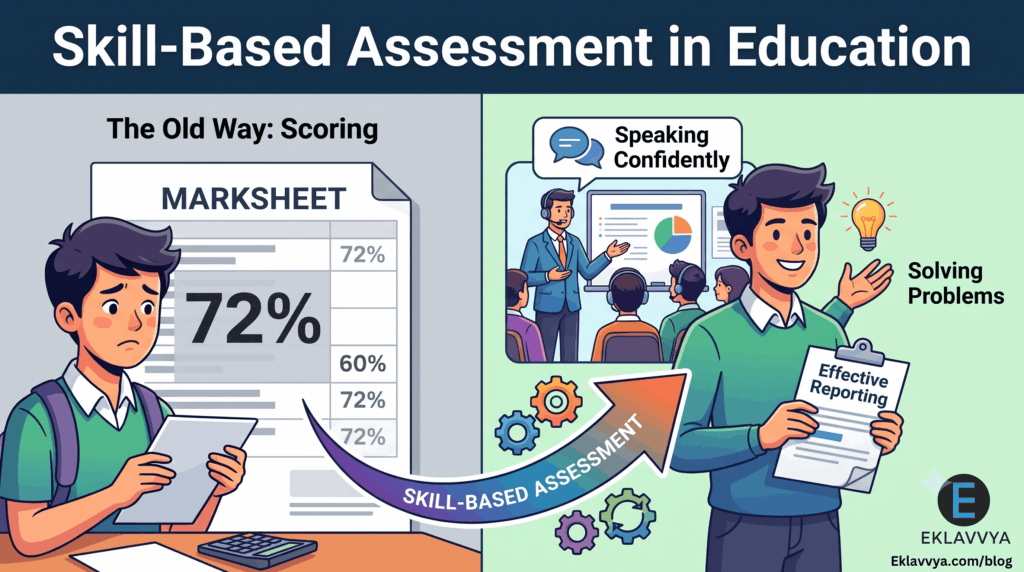
A student graduates with 72% in their final exams. An employer looks at that number and still cannot answer the only question that matters: can this person speak confidently with a customer, solve an unfamiliar problem, or write a clear report? The marksheet is silent on all three.
This gap has real consequences. According to the India Skills Report 2026, only 56.35% of Indian graduates are considered employable, and 82% of employers report difficulty finding right-fit talent. Institutions produce marks. Employers need skills. Skill-based assessment in education closes that gap by measuring and certifying specific competencies, not a single aggregate score.
This guide explains what skill-based assessment is, why NEP 2020 makes it urgent, how it works in practice, and how universities can implement it this academic year.
What Is Skill-Based Assessment?
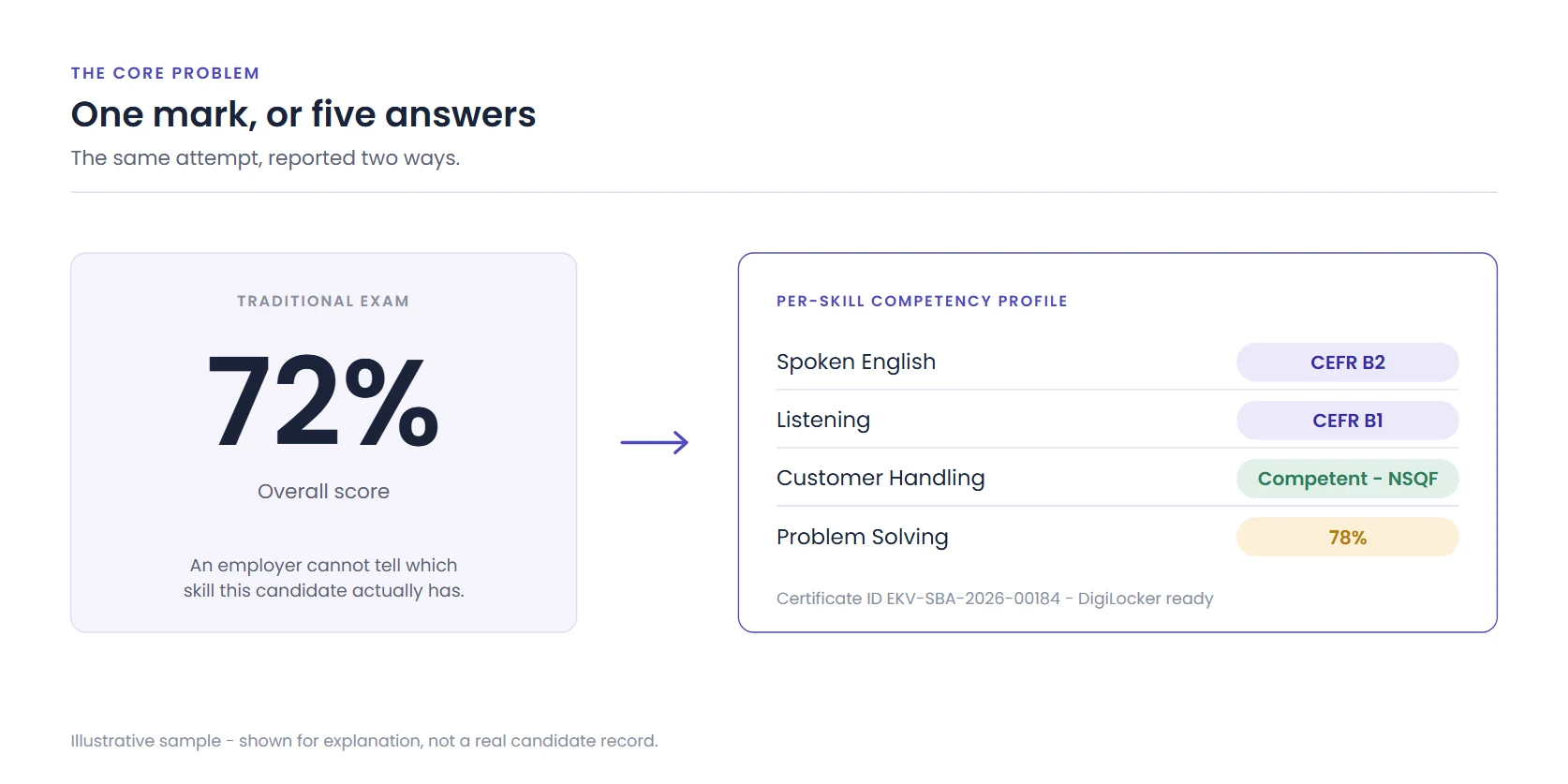
Skill-based assessment is an evaluation method where every question is tagged with the specific competencies it measures, such as Speaking, Listening, Problem Solving, or Customer Handling, and scored against a defined rubric. Instead of one total mark, the student receives a per-skill competency profile. For example, a result may read: Spoken English at CEFR level B2, Problem Solving 78%, Customer Handling at NSQF level Competent.
Think of it like a medical report versus a single “health score”. A doctor does not tell you that your body scored 72%. They report blood pressure, sugar levels, and heart rate separately, because each one drives a different action. Skill-based assessment does the same for learning outcomes.
The Three Building Blocks
- Skill-tagged questions – each question declares which competencies it measures and their weightage
- Scoring frameworks – rubrics map raw scores to recognized levels such as CEFR bands for language or NSQF levels for vocational skills
- Per-skill reporting – results show a competency profile per student, often with a verifiable digital credential
Why Marks Alone No Longer Work
A single percentage compresses dozens of different abilities into one number, and important signals get lost in that compression. Two students with identical marks can have completely different strengths. One writes brilliantly but freezes in interviews. The other communicates well but struggles with analysis.
The gap between degrees and employability is not uniform. It varies sharply by stream, which is exactly the kind of signal a single marksheet hides:
Here is how the two approaches compare for a typical institution:
| Dimension | Traditional Marks-Based Exam | Skill-Based Assessment |
|---|---|---|
| Output | One total score (e.g., 72%) | Per-skill profile (e.g., Speaking B2, Writing B1) |
| Question design | Tests recall of syllabus content | Tests application of tagged competencies |
| Answer formats | Mostly written | Text, audio, video, and live AI conversation |
| Employer value | Low – score reveals little | High – verifiable levels per skill |
| Student feedback | Pass or fail, no direction | Shows exactly which skills to improve |
| NEP 2020 alignment | Weak | Strong – competency-based by design |
- Assess speaking, writing, and problem solving in one platform
- Get a per-skill competency profile for every student
- Align assessments with NEP 2020, CEFR, and NSQF
The Policy Push: NEP 2020, NSQF, and Employability
Skill-based assessment is no longer optional for Indian institutions. NEP 2020 explicitly directs universities to move away from rote memorization towards competency-based evaluation that develops critical thinking, problem solving, and creativity. The NEP 2020 assessment requirements already ask institutions to document learning outcomes for accreditation.
Two frameworks make this practical:
NSQF: The National Skills Qualification Framework
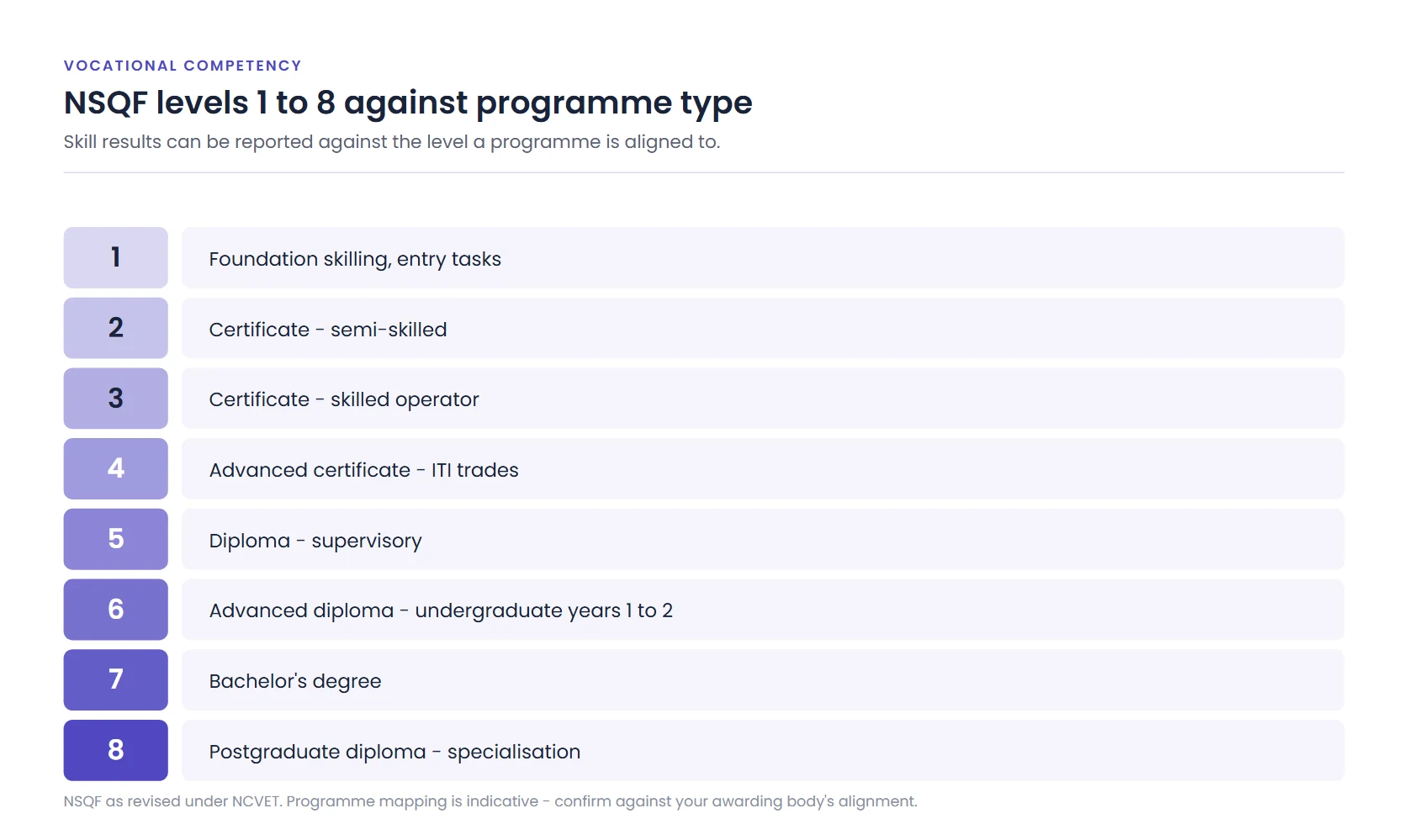
The revised NSQF (notified by NCVET in June 2023) defines 8 principal competency levels with half-levels in between. Qualification Packs break each vocational role into National Occupational Standards (NOS) with clear performance criteria. When an assessment maps questions to NOS, the institution can certify students at a recognized NSQF level, and results can post to DigiLocker as verifiable credentials. Details are published on the official National Qualification Register.
CEFR: The Global Standard for Language Skills
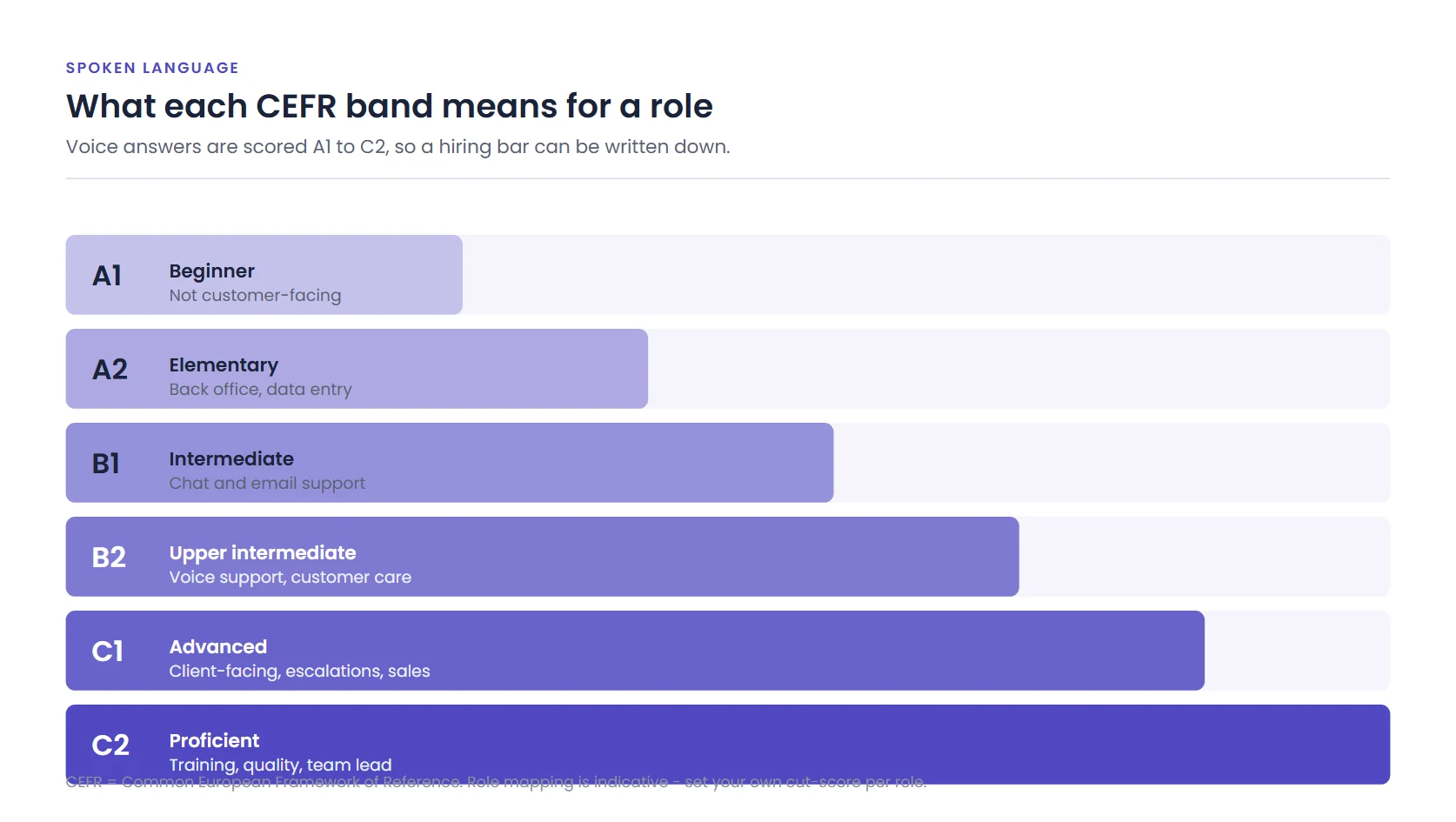
The Common European Framework of Reference (CEFR) grades language ability across six levels from A1 to C2. It scores spoken performance on range, accuracy, fluency, interaction, coherence, and pronunciation. For placement-focused programs, certifying that a student speaks English at B2 says far more than “scored 68% in English”.
How Skill-Based Assessment Works: Step by Step
A modern skill-based assessment platform follows a clear workflow. Here is the process from question authoring to certification:
🧩 Define the skills
Pick from standard competencies (Listening, Speaking, Problem Solving) or create custom ones like Negotiation or Lab Safety.
✍️ Author skill-tagged questions
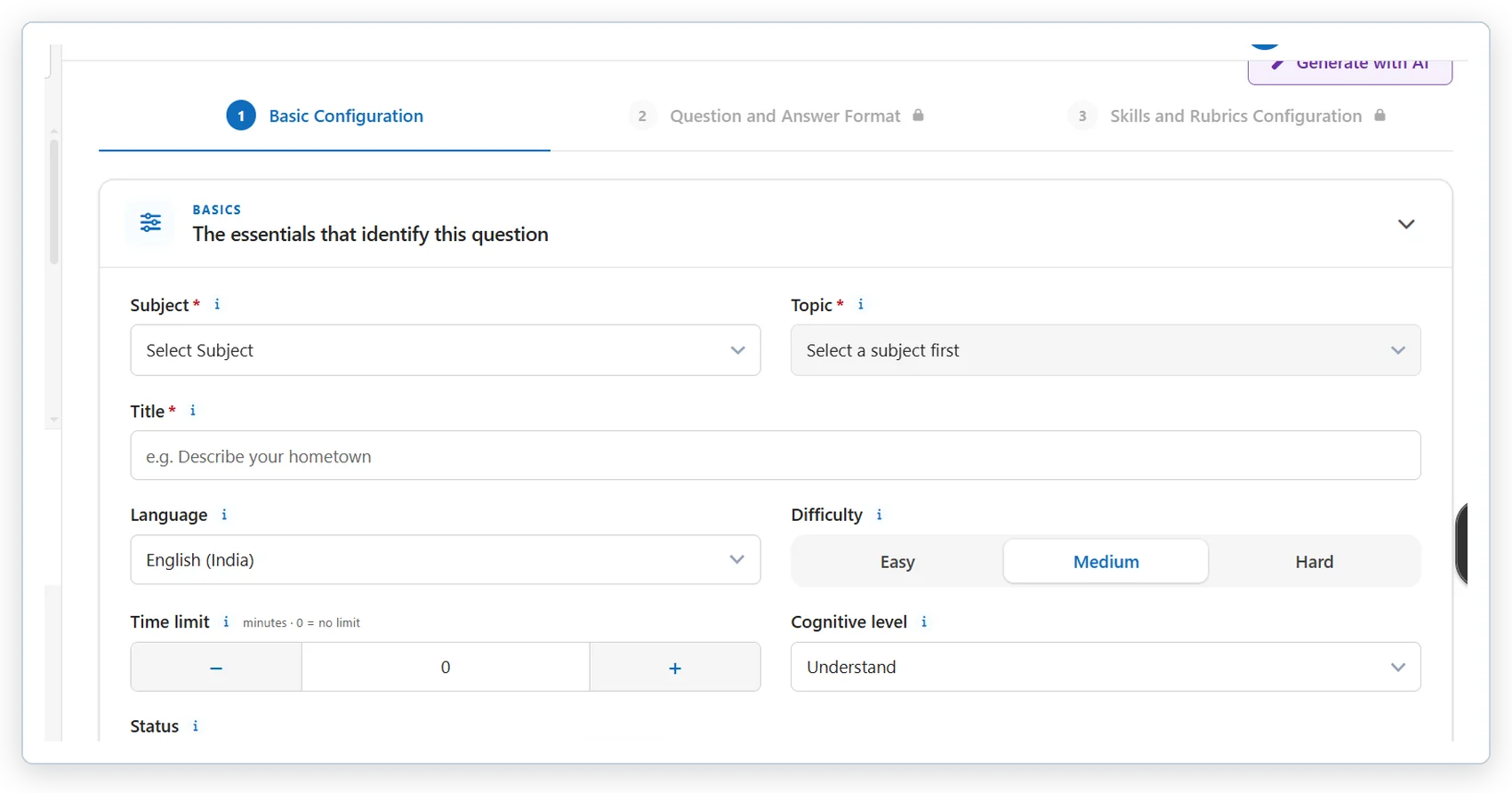
Combine any stimulus format (text, video, audio, image, or a case study) with any answer format (text, audio, video, or a multi-turn AI conversation). AI-assisted authoring drafts the question, skills, and rubric from a one-line prompt.
📏 Attach a scoring rubric
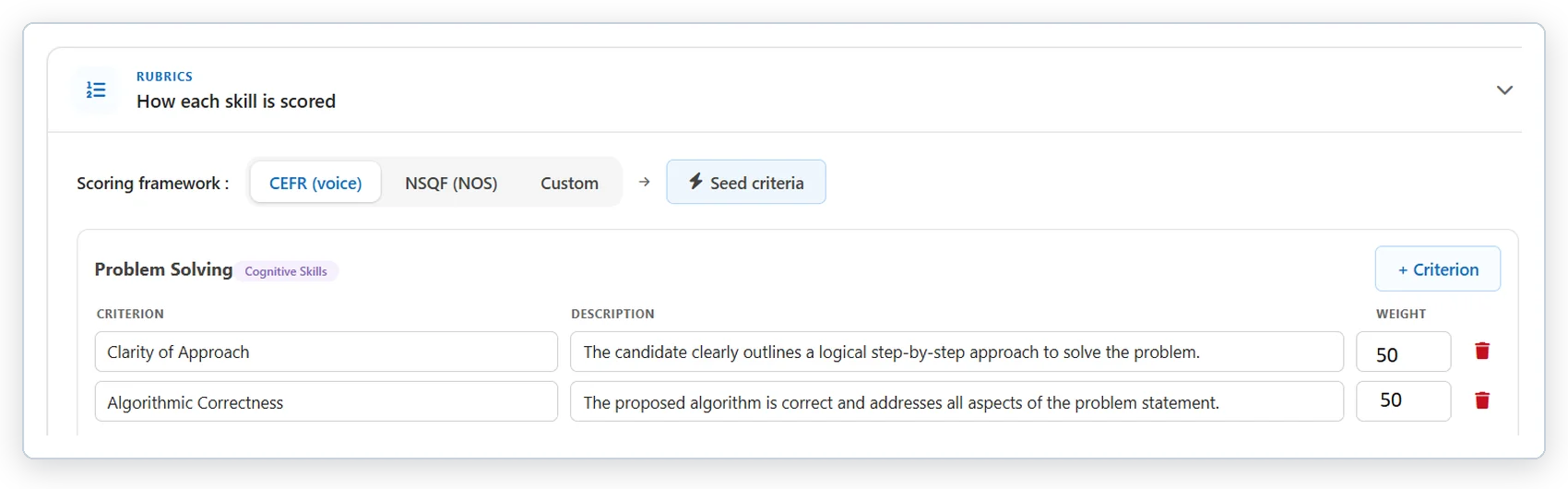
Choose CEFR for spoken language, NSQF performance criteria for vocational roles, or a custom rubric with weighted criteria.
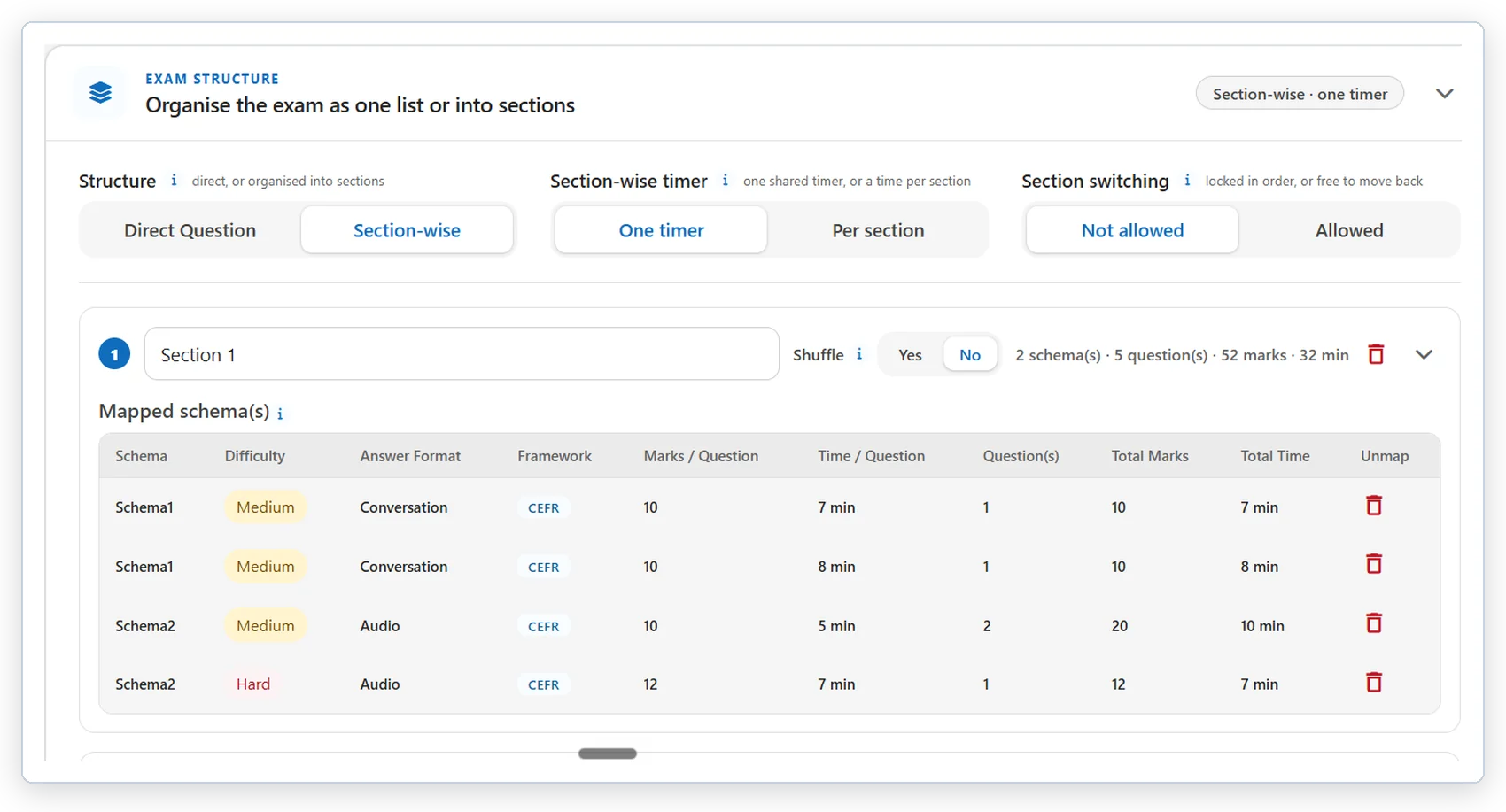
🗂️ Assemble with a blueprint
A live skill-coverage panel shows whether the paper actually tests the intended skill mix, for example 40% communication and 30% problem solving.
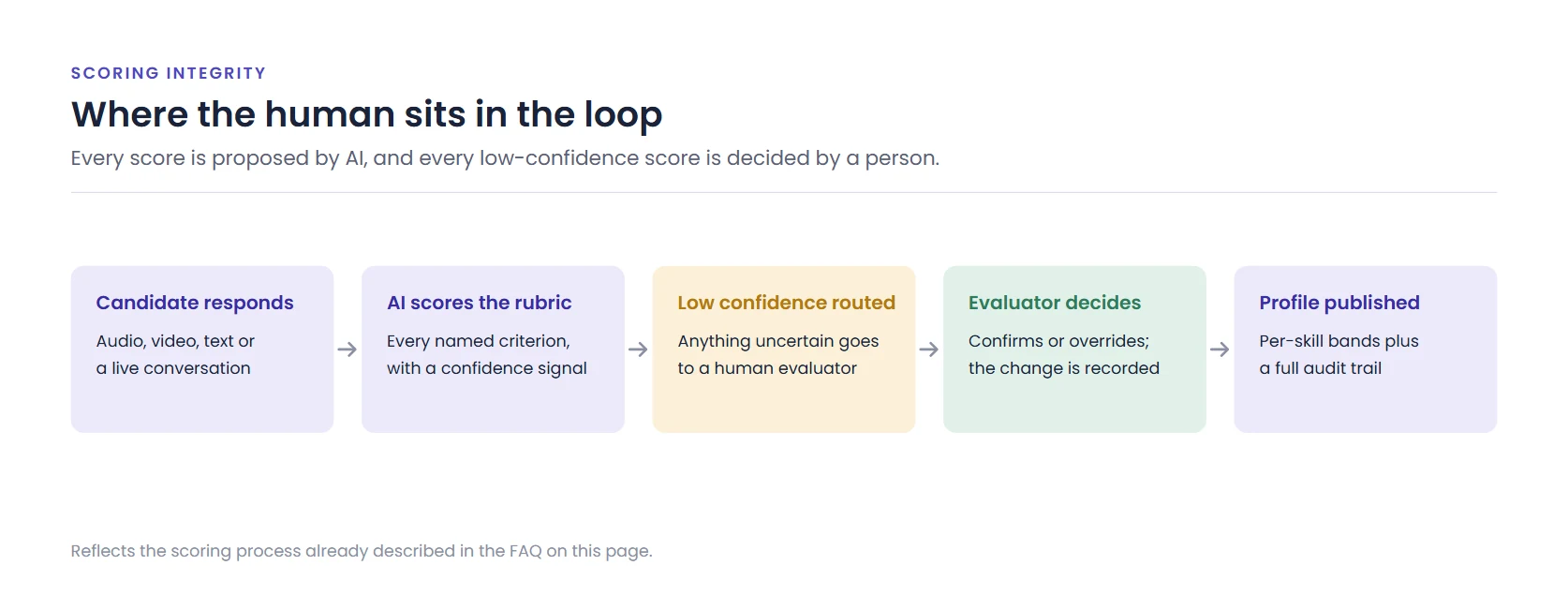
🤖 AI scores, humans verify
AI evaluates each response against the rubric with a confidence signal. Low-confidence or flagged responses route automatically to a human reviewer. Speed without sacrificing fairness.
📊 Publish per-skill results
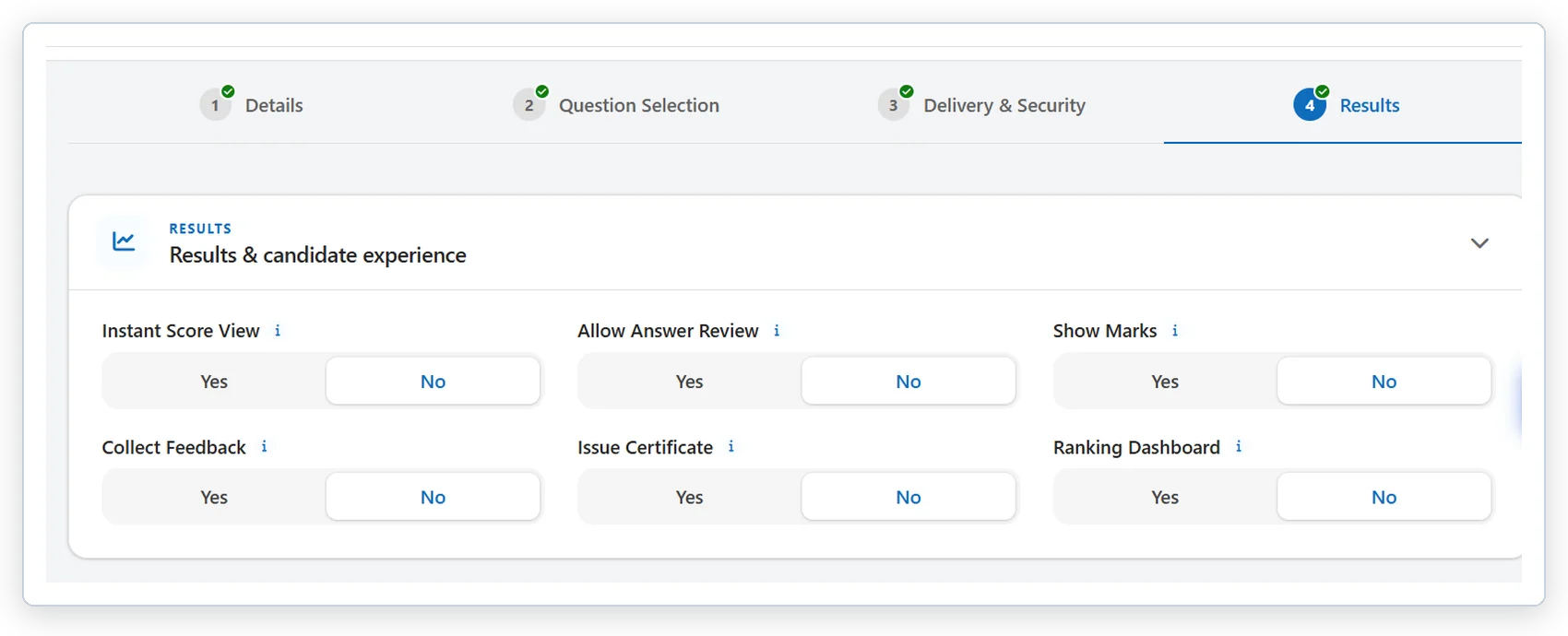
Students receive a radar-style competency profile with framework levels per skill, plus a QR-verifiable certificate that can integrate with DigiLocker.
The end result looks like this for each student – a profile, not a percentage:
Pick a skill, edit criteria and weights, then click the level a student reached in each row.
Try a free spoken communication test →
| Criterion | Weight | Beginning (1) | Developing (2) | Competent (3) | Advanced (4) |
|---|---|---|---|---|---|
| % | |||||
| % | |||||
| % | |||||
| % |
Total weight: 100%
Weights should total 100%; the score is scaled to the current total.
Sample rubric. Adapt descriptors to your course outcomes. For spoken English, universities often map to CEFR bands (A1–C2); these four levels are a simplified classroom rubric, not a CEFR level.
Weighted score: 63.8% · Band: Developing
- Fluency & coherence: Competent (3/4), 22.5 of 30 points
- Pronunciation & clarity: Developing (2/4), 10 of 20 points
- Vocabulary & grammar: Competent (3/4), 18.75 of 25 points
- Interaction (turn-taking, handling follow-ups): Developing (2/4), 12.5 of 25 points
Improvement focus: Interaction (turn-taking, handling follow-ups), now Developing (2/4).
Score = sum of weight × level ÷ 4. A sample student is preloaded. Nothing is sent or stored.
Scoring hundreds of students this way? Eklavvya applies the rubric per skill, with AI scoring and human review for borderline answers.
The Conversation Format: Assessing Real Interaction
The most distinctive answer format is the multi-turn AI conversation. The student speaks with an AI interviewer that responds naturally, asks follow-up questions, and adapts to their answers. This captures interactional competence, such as turn-taking and handling unexpected questions, that a recorded monologue cannot measure. It works like the AI video interview technology already used in admissions, extended with rubric-based skill scoring.
Key Benefits for Educational Institutions
Institutions adopting skill-based assessment see benefits across academics, placements, and accreditation:
- Improves placement outcomes – students walk into interviews with certified skill levels employers can verify in seconds
- Strengthens NEP 2020 and accreditation evidence – per-skill data documents learning outcomes for NAAC and NBA reviews
- Targets remediation precisely – faculty see exactly which skills lag, per student and per cohort, instead of guessing from aggregate marks
- Scales oral assessment – AI conversation and audio formats let one institution assess thousands of students’ speaking skills without scheduling thousands of viva slots
- Reduces evaluation bias – rubric-based AI scoring applies the same criteria to every response, with human review reserved for edge cases
- Builds employability skills visibility – students track their own skill growth semester over semester, not just their grades
- Certify spoken English at CEFR levels for your placement cohort
- Map vocational programs to NSQF levels with DigiLocker credentials
- Give every student a skill profile employers trust
Practical Use Cases in Education
🎯 1. Employability Skills Testing for Final-Year Students
Run a campus-wide employability assessment covering communication, problem solving, and domain skills before placement season. The per-skill report tells the training and placement cell exactly which students need communication coaching and which need technical practice. This converts a generic “soft skills workshop” into targeted intervention.
🗣️ 2. Spoken English Certification with CEFR
Language labs can replace subjective viva marks with CEFR-mapped speaking assessments. Students answer through audio or AI conversation. The system scores fluency, accuracy, and interaction, then certifies a level from A1 to C2 that international employers and universities recognize.
🛠️ 3. Vocational and Skill University Programs
Skill universities and community colleges running NSQF-aligned programs can assess students against actual NOS performance criteria. Results certify “Competent” or “Not Yet Competent” per standard, exactly as NCVET assessment guidelines expect.
📈 4. Continuous Competency Tracking Under NEP
Semester-wise skill assessments build a longitudinal profile. A student can see their Speaking move from B1 to B2 across two years. That progression evidence also feeds outcome-based education reports for accreditation.
How Eklavvya Supports Skill-Based Assessment
Eklavvya, which already powers online examinations and AI-proctored remote assessments for 200+ universities and institutions including TISS, NMIMS, and SPPU, is launching a dedicated Skill-Based Assessment module in August 2026.
The module lets examination teams author skill-tagged questions in any format, including multi-turn AI voice conversations, score them against CEFR, NSQF, or custom rubrics, and publish per-skill competency profiles with QR-verifiable certificates. AI handles first-pass scoring with confidence signals, and a built-in review queue routes doubtful responses to human evaluators. Institutions can start with a single employability test and scale to program-wide competency certification on the same platform they already use for exams.
Key Takeaways
- Only 56.35% of Indian graduates are employable (India Skills Report 2026), while 82% of employers struggle to find right-fit talent
- Skill-based assessment replaces one aggregate mark with a per-skill competency profile
- Every question is tagged with the skills it measures and scored against a rubric
- CEFR maps spoken language to levels A1-C2; NSQF maps vocational skills to 8 principal levels
- Answer formats include text, audio, video, and multi-turn AI conversations that test real interaction
- Hybrid scoring combines AI speed with human review for low-confidence responses
- Verifiable credentials (QR, DigiLocker) let employers trust results during placements
- NEP 2020 and the revised NSQF make competency-based evaluation a compliance need, not just a best practice
Conclusion
Marks tell students how they ranked. Skill-based assessment tells them, and their future employers, what they can actually do. With NEP 2020 pushing competency-based evaluation and employers demanding verified skills, institutions that adopt skill-based assessment now will lead placement outcomes over the next decade.
The technology barrier has disappeared. AI scoring, conversation-based speaking tests, and framework-mapped rubrics are available today on the same platforms institutions already use for online exams. The question is no longer whether to assess skills, but which cohort to start with this semester.
- See the Skill-Based Assessment module before the August launch
- Run a pilot employability assessment for one department
- Get a sample per-skill competency report for your team
Frequently Asked Questions
What is skill-based assessment in education?
Skill-based assessment measures specific competencies such as speaking, problem solving, or customer handling instead of a single overall mark. Every question is tagged with the skills it measures and scored against a rubric. The student receives a per-skill competency profile, for example CEFR level B2 in spoken English, rather than one aggregate percentage.
How is skill-based assessment different from traditional exams?
Traditional exams produce one score that mixes many abilities together, so a 72% tells an employer very little. Skill-based assessment tags each question with defined competencies and scores them separately against frameworks like CEFR or NSQF. The output is a skill profile showing exactly where the student is strong and where they need support.
Does skill-based assessment support NEP 2020 requirements?
Yes. NEP 2020 asks universities to move from rote memorization to competency-based evaluation, and the revised NSQF (NCVET, 2023) plus the National Credit Framework support stackable, skill-linked credentials. Skill-based assessment platforms map questions to competencies and NSQF levels, generating the outcome evidence institutions need for NEP alignment and accreditation.
How are speaking and communication skills assessed online?
Students answer through audio, video, or a multi-turn AI conversation that simulates a real interview. Speech-to-text and AI scoring evaluate range, accuracy, fluency, interaction, coherence, and pronunciation, then map the result to a CEFR level from A1 to C2. Low-confidence responses are routed to a human reviewer for a final decision.
Can students receive certificates for skill-based assessments?
Yes. Modern platforms issue verifiable digital credentials that state the assessed skill levels, for example CEFR B2 in spoken English or an NSQF competency result. Certificates can carry QR-based verification and integrate with DigiLocker, so employers can trust the result during placements and recruitment.