Every recruiter has lived this moment. A candidate’s resume says “excellent communication skills”. Three interview rounds and one offer later, the new hire cannot handle a difficult customer call. The resume did not lie, exactly. It was just never evidence.
The scale of this problem is now measurable. Around 85% of employers say they practice skills-based hiring, yet 53% admit verifying skill claims is their biggest obstacle. Companies want to hire for skills. Most simply lack a reliable way to measure them. Skill-based assessment gives HR that missing instrument: structured, rubric-scored evidence of what a candidate or employee can actually do.
This guide covers why skills-based hiring has overtaken degree filters, how skill-based assessment works for recruitment and L&D, and where to apply it first.
The Skills-Based Hiring Shift Is Already Here
Degree-based screening is fading fast. Only 18% of US job postings still list degree requirements, and roles dropping degree filters grew four-fold between 2014 and 2023 (National University hiring statistics, 2026). In India, the pressure is sharper: the India Skills Report 2026 finds 82% of employers struggle to find right-fit talent, with a projected deficit of 47-49 million skilled workers by 2027.
The reskilling pressure inside existing workforces is just as concrete. The WEF breaks down what happens to every 100 workers by 2030:
What Is Skill-Based Assessment for Corporates?
Skill-based assessment is a structured evaluation where every question is tagged with the competencies it measures and scored against a defined rubric. Instead of a pass/fail aptitude score, each candidate or employee receives a per-skill profile: Spoken English at CEFR B2, Customer Handling 78%, Escalation Judgment “Competent”.
Three elements distinguish it from a generic online test:
- Role-mapped skills – assessments mirror the actual competency mix of the job, such as 40% customer handling, 30% communication, 30% problem solving
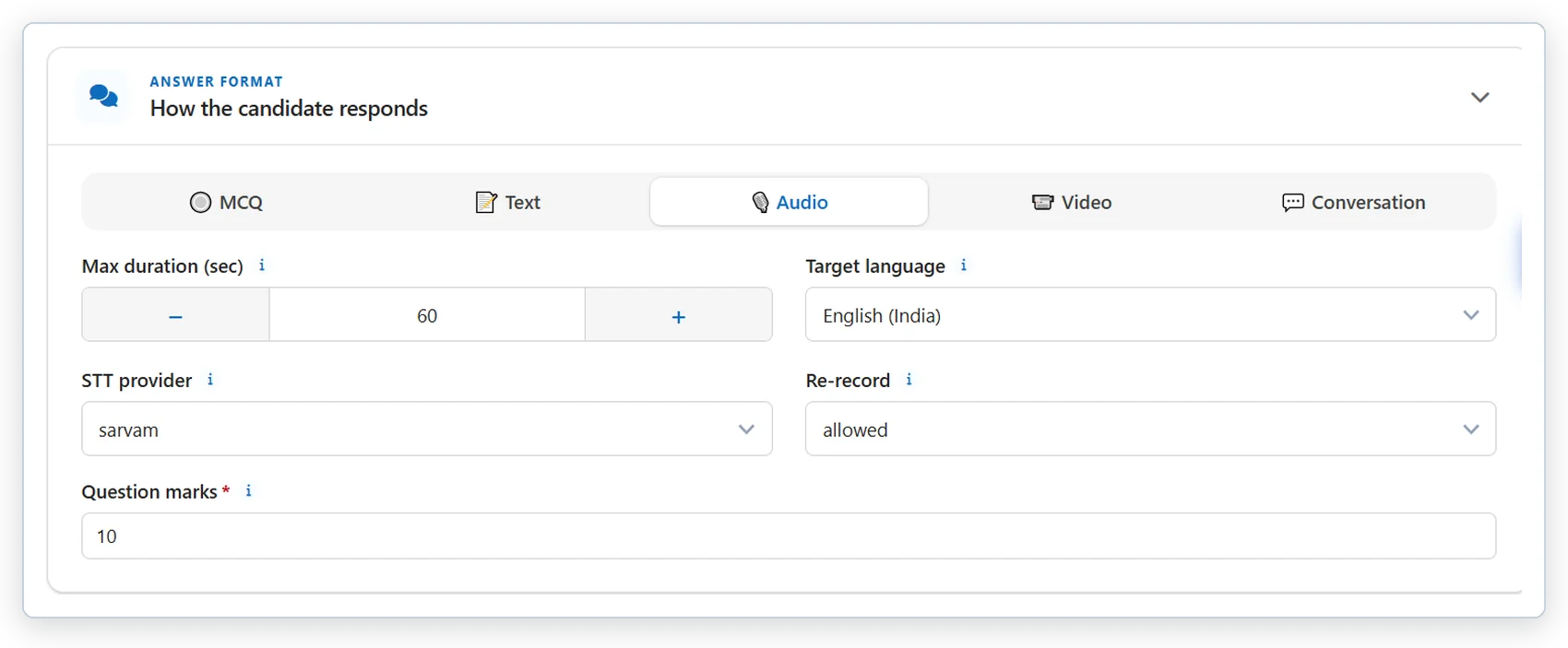
- Real-performance formats – candidates respond by text, audio, video, or a multi-turn AI conversation that simulates a live customer or stakeholder interaction
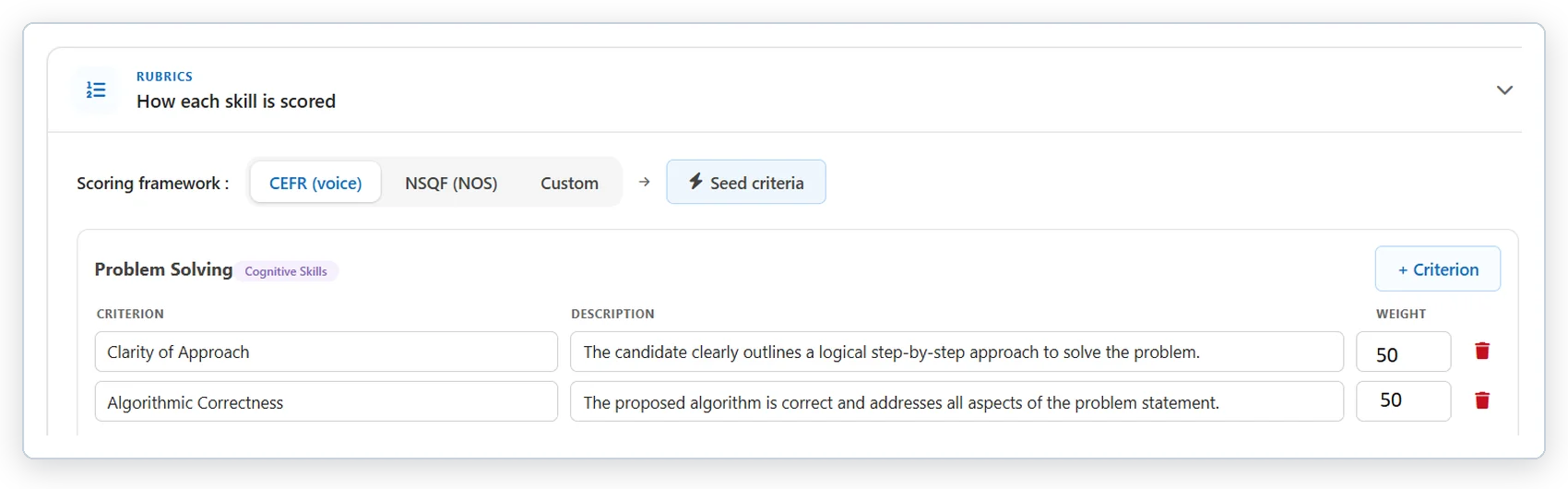
- Rubric plus framework scoring – responses map to recognized standards like CEFR for language or NSQF National Occupational Standards for vocational roles, or to your own competency model
- Screen thousands of candidates on real skills, not resume claims
- AI conversation interviews for communication-heavy roles
- Per-skill reports your hiring panel can defend
How It Works: From Role Profile to Hiring Decision
A skill-based hiring assessment follows a repeatable workflow:
🧭 Map the role to skills
Break the job into 4-6 competencies. For a customer care role: greeting and identification, understanding the need, resolution accuracy, courteous closure.
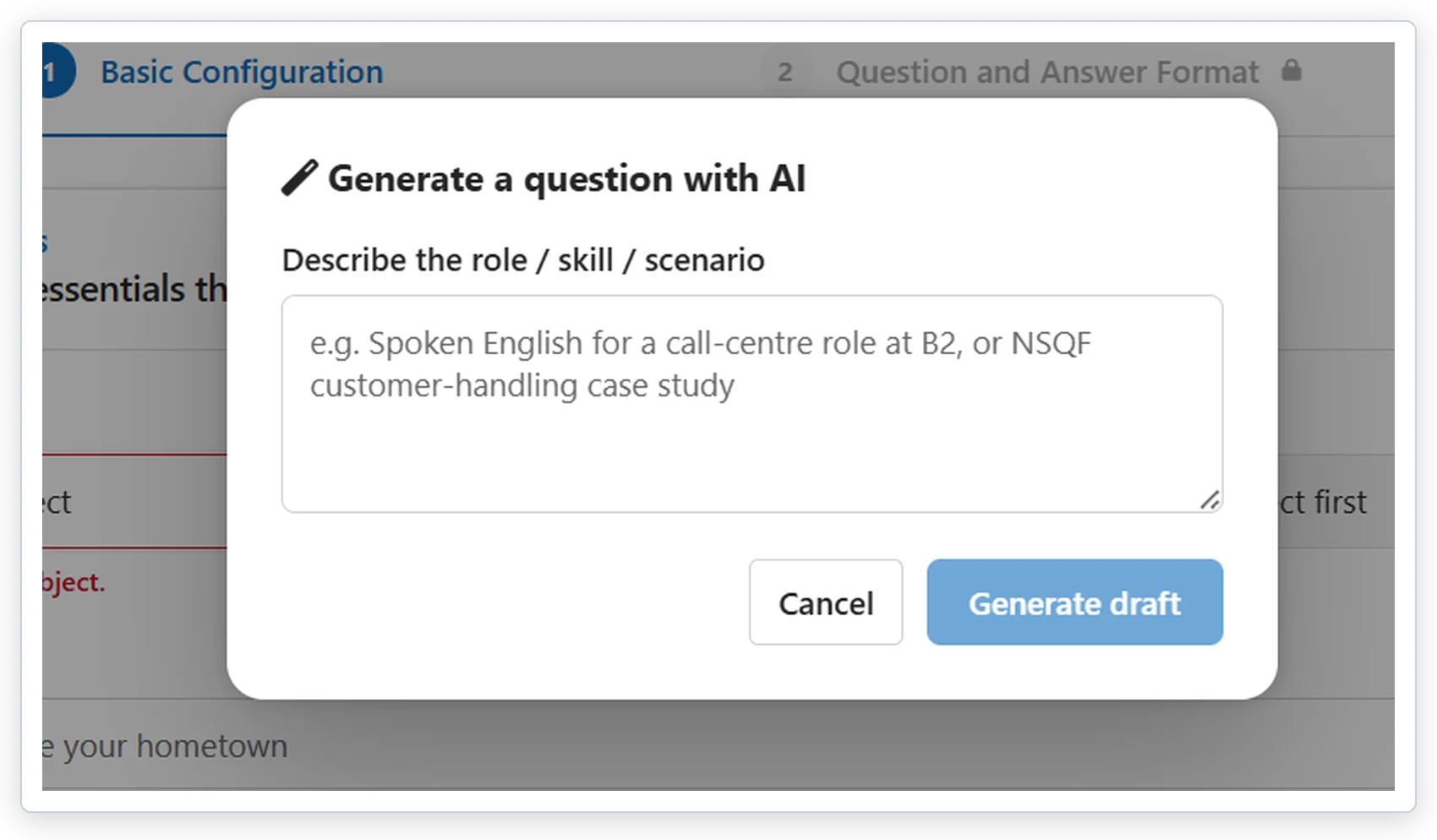
✍️ Author scenario questions
Combine a case-study stimulus (an angry-customer audio clip, a policy document, a product image) with the answer format that matches the skill. Speaking skills need voice answers, not multiple choice.
💬 Run the AI conversation round
For interactive skills, candidates talk with an AI interviewer that asks follow-ups and adapts. This measures turn-taking, composure, and judgment that recorded monologues miss.
🤖 Score with AI, verify with humans
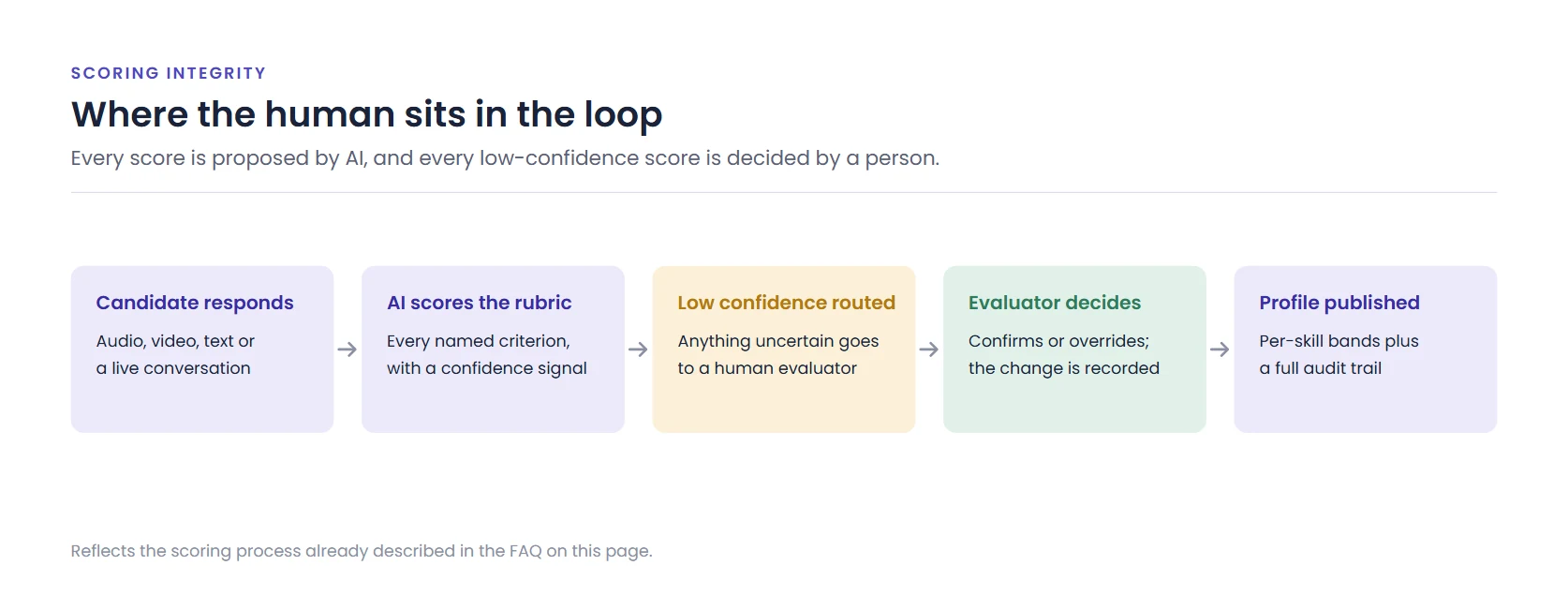
AI evaluates each response against the rubric and attaches a confidence signal. Low-confidence or borderline responses route to a human reviewer automatically. Every score has an audit trail.
📊 Compare per-skill profiles
Recruiters see a radar-style skill profile per candidate, so two applicants are compared on evidence, criterion by criterion, instead of interviewer gut feel.
Example: Screening a Customer Care Executive
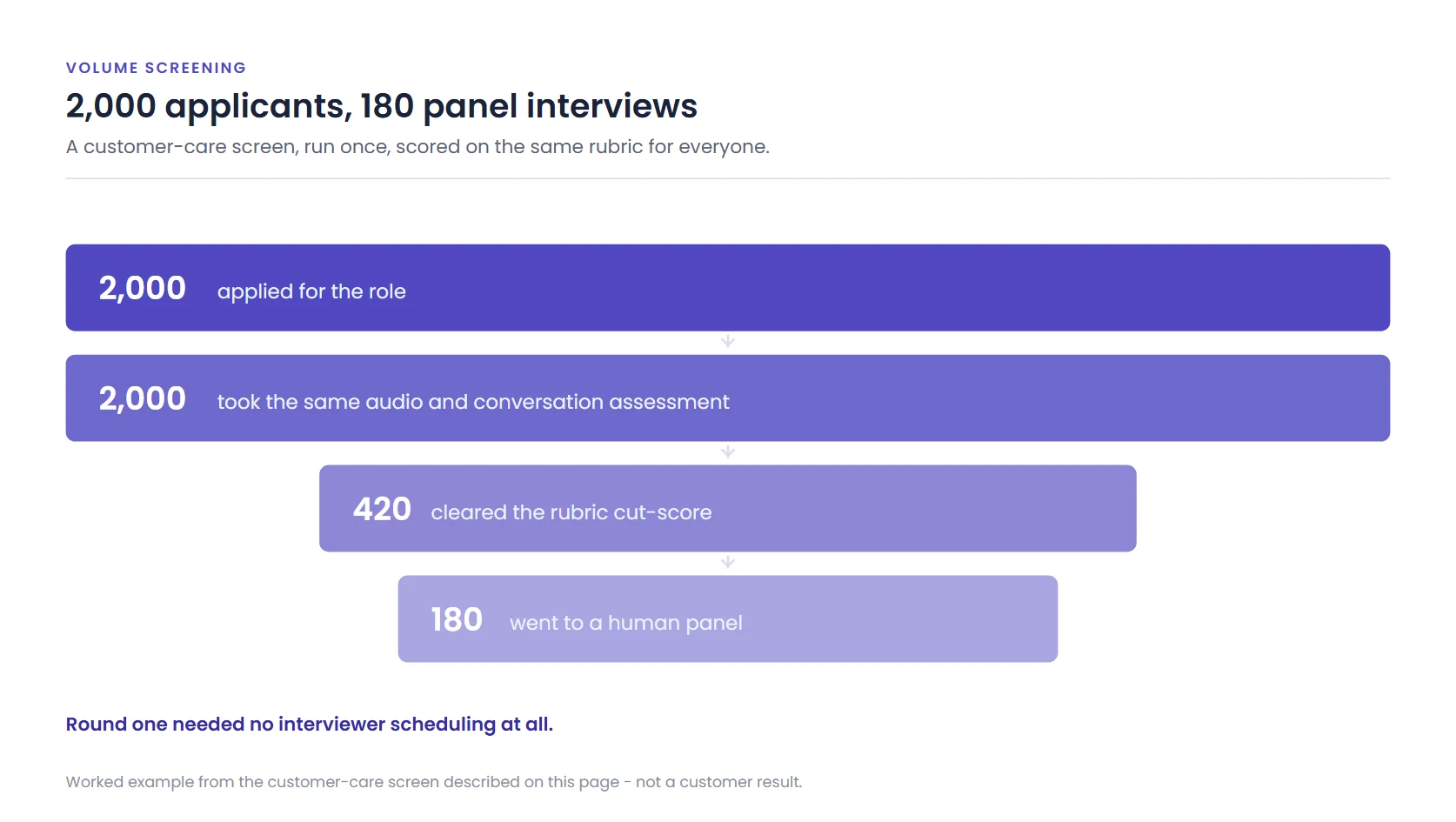
A BPO screens 2,000 applicants for voice-process roles. Each candidate completes a 25-minute assessment: a CEFR-scored speaking task, an AI conversation simulating a damaged-order complaint, and a short written scenario. The system auto-clears candidates scoring B2 or above with “Competent” customer handling, routes borderline cases to human reviewers, and produces a ranked shortlist in 48 hours. Round-one interviewer hours drop to near zero.
Pick a role, adjust the competencies and weights, and get a blueprint with answer formats, timings and a shortlist rule to share with your hiring panel.
Suggested starting point. Adjust to your job description.
Competencies (up to 6)
Minutes per competency are editable assumptions.
Your assessment blueprint
- Spoken English · 30% · Voice answer · 6 min
- Customer handling · 30% · AI conversation · 8 min
- Problem solving · 20% · Written scenario · 6 min
- Escalation judgement · 20% · MCQ / situational judgement · 5 min
Total: 100% weight · 25 min
Shortlist when the weighted score is ≥ 65% and no competency is below 50%.
Shortlist rule
Candidate score check
Enter a sample candidate’s score per competency (pre-filled with sample values).
✗ Do not shortlist. Weighted score 66% meets the 65% cutoff. Below the 50% floor: Escalation judgement (45%).
Minutes, cutoff and floor are editable assumptions, not benchmarks. Everything is calculated in your browser; nothing is sent or stored.
Run this blueprint for real: Eklavvya delivers voice, AI-conversation and written tasks and scores them per skill.
See skill-based assessment →Try a free AI interviewBeyond Hiring: Skill Assessment in L&D and Workforce Planning
The same assessment engine answers L&D’s hardest question: what should we train, and did the training work?
🔍 Skill-Gap Analysis Before Training Spend
Baseline the team’s actual skill levels before commissioning training. WEF data shows 59 of every 100 workers will need reskilling by 2030. A per-skill baseline tells you which 59, and on which skills, so budget goes where the gaps are.
📈 Measuring Training Effectiveness
Run the same rubric-scored assessment before and after a program. If Spoken Interaction moves from B1 to B2 across the cohort, the program worked. If not, you have evidence to change vendors instead of renewing on faith.
🪜 Promotions and Internal Mobility
Internal moves often fail for the same reason external hires do: assumed skills. Assessing candidates for a team-lead role on escalation handling and communication produces a defensible, bias-resistant basis for the decision, with human review built into the loop.
🎓 Campus Hiring and Employability Pipelines
Corporates hiring at campus scale can run standardized employability assessments across colleges, then compare candidates from different institutions on identical rubrics. Verified skill credentials, with QR-based verification, also let pre-assessed candidates carry their results into your pipeline, shrinking screening time further.
- Baseline your workforce’s skills before the next training budget
- Standardize campus hiring across every college you visit
- Prove training ROI with before-and-after skill profiles
Key Benefits for HR and L&D Teams
- Cuts mis-hires – decisions rest on demonstrated performance in role-realistic scenarios, not self-reported claims
- Scales the first interview round – AI conversation assessments screen thousands of candidates in parallel
- Makes decisions defensible – every score traces to a rubric criterion with an audit trail and human review for edge cases
- Reduces interviewer bias – the same rubric is applied to every candidate, and identity-blind scoring is possible
- Turns L&D into a measurable function – skill baselines and deltas replace attendance sheets as the metric of training success
- Improves retention – skills-matched hires stay longer; skills-based organizations report up to 98% higher retention of high performers
Traditional Screening vs Skill-Based Assessment
| Dimension | Resume + Unstructured Interview | Skill-Based Assessment |
|---|---|---|
| Evidence | Self-reported claims | Scored performance on role scenarios |
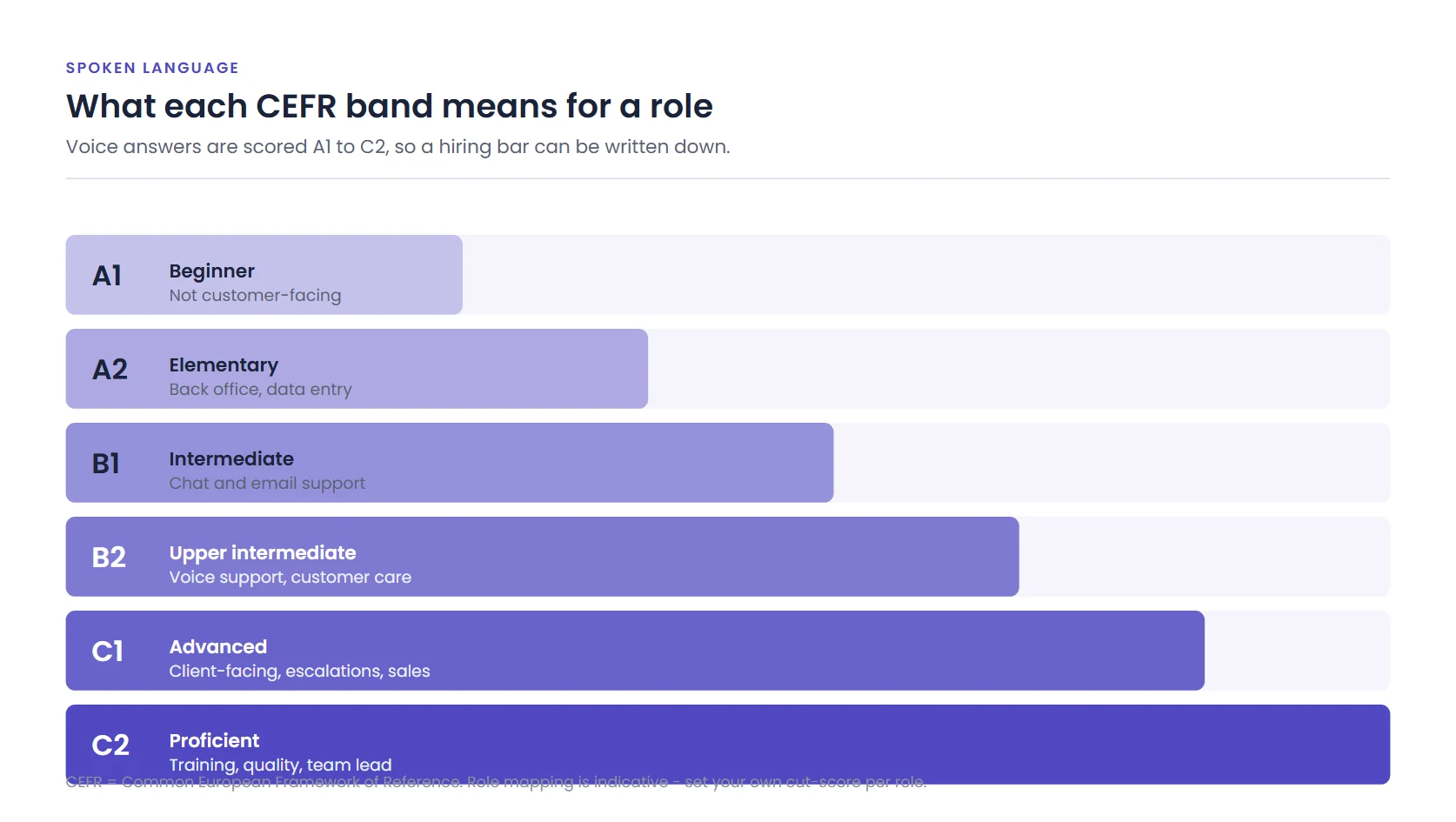
| Communication skills | Impression from conversation | CEFR level from voice/AI-conversation tasks |
| Consistency | Varies by interviewer and mood | Same rubric for every candidate |
| Scale | Limited by interviewer hours | Thousands assessed in parallel |
| Audit trail | Sparse notes | Per-criterion scores, confidence, reviewer log |
| L&D reuse | None | Same engine for gap analysis and training ROI |
How Eklavvya Supports Corporate Skill Assessment
Eklavvya has run secure online assessments and AI-driven video interviews for 200+ organizations and institutions, processing 100,000+ evaluations per session at peak. In August 2026, the platform is launching a dedicated Skill-Based Assessment module built for exactly the workflows above.
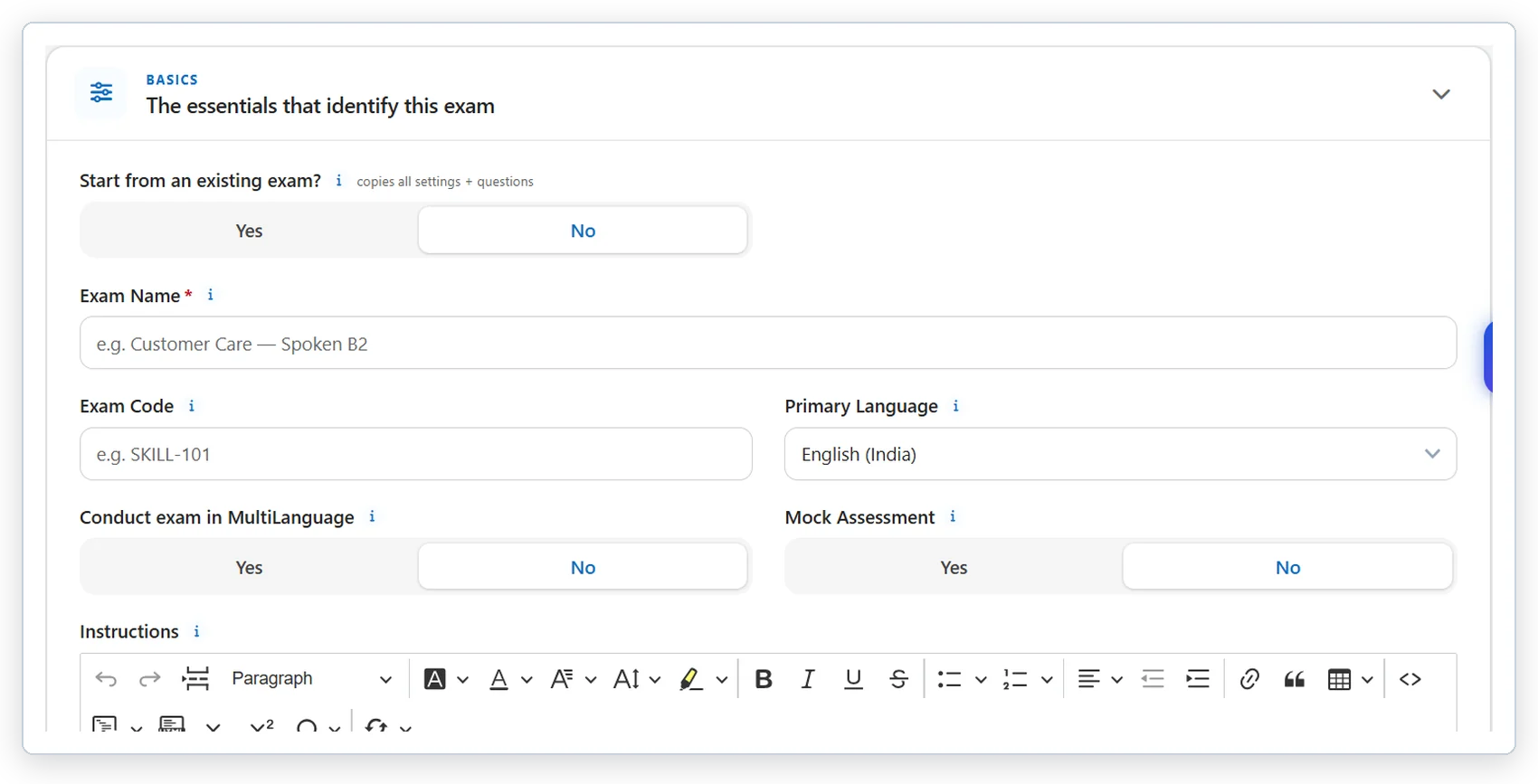
HR teams can author skill-tagged questions in any format, including multi-turn AI voice conversations in English and Indian languages, score against CEFR, NSQF National Occupational Standards, or fully custom competency rubrics, and review AI-flagged responses in a built-in queue. Results publish as per-skill radar profiles with verifiable, QR-backed credentials. The same platform handles AI proctoring, so remote assessments stay credible.
Key Takeaways
- 85% of employers claim skills-based hiring, but 53% say verifying skill claims is their biggest obstacle
- 39% of current skills will transform or become outdated by 2030 (WEF), making degree-era screening unreliable
- Skill-based assessment scores role-realistic performance against rubrics, producing per-skill candidate profiles
- Multi-turn AI conversation interviews measure live interaction skills that recorded answers cannot
- Hybrid AI-plus-human scoring keeps assessments fast, fair, and auditable
- The same engine powers L&D: skill-gap baselines, training ROI measurement, and promotion decisions
- CEFR levels standardize communication screening for customer-facing and BPO roles
- Skills-based organizations report up to 98% higher retention of high performers
Conclusion
The skills-based hiring movement has a verification problem, and skill-based assessment is the fix. When every hiring and promotion decision rests on rubric-scored evidence, recruitment gets faster, fairer, and easier to defend, and L&D finally gets a measurement instrument instead of a feedback form.
Organizations that build this muscle now will out-hire competitors still filtering by degree and gut feel. The tooling, from AI conversation interviews to framework-mapped scoring, is ready today.
- Preview the Skill-Based Assessment module launching this August
- Pilot a skill-scored screening round for one open role
- Get a sample per-skill candidate report for your hiring panel
Frequently Asked Questions
What is skill-based assessment in recruitment?
Skill-based assessment in recruitment evaluates candidates on the specific competencies a role requires, such as communication, problem solving, or customer handling, instead of relying on resumes and degrees. Candidates complete scenario questions, audio or video responses, or AI conversation interviews. Each response is scored against a rubric, producing a per-skill report recruiters can compare objectively across candidates.
Why is skills-based hiring replacing degree-based hiring?
Degrees are weak predictors of job performance, and skills change fast. The World Economic Forum estimates 39% of existing skills will transform or become outdated by 2030. Around 70% of employers already use some form of skills-based hiring, and organizations that hire for verified skills report significantly higher retention of high performers. The main obstacle is verification, which structured skill assessments solve.
How does an AI conversation interview assess candidates?
The candidate speaks with an AI interviewer that asks role-relevant questions, listens, and responds with natural follow-ups. The conversation is scored against a rubric covering competencies like spoken fluency, customer handling steps, or escalation judgment. AI assigns scores with a confidence signal, and low-confidence responses go to a human reviewer, so every hiring decision has an auditable basis.
Can skill-based assessments be used for existing employees, not just hiring?
Yes. L&D teams use the same assessments to baseline workforce skills, identify gaps before designing training, measure improvement after programs, and support promotion or internal mobility decisions with objective per-skill data. A radar-style skill profile per employee makes gaps and progress visible at individual and team level.
How do you assess communication skills for customer-facing roles at scale?
Voice-based assessments scored against the CEFR framework grade spoken English from A1 to C2 on range, accuracy, fluency, interaction, coherence, and pronunciation. A multi-turn AI conversation simulates a real customer call, so you measure how candidates actually handle a live interaction. Thousands of candidates can be assessed in parallel without scheduling human interviewers for round one.